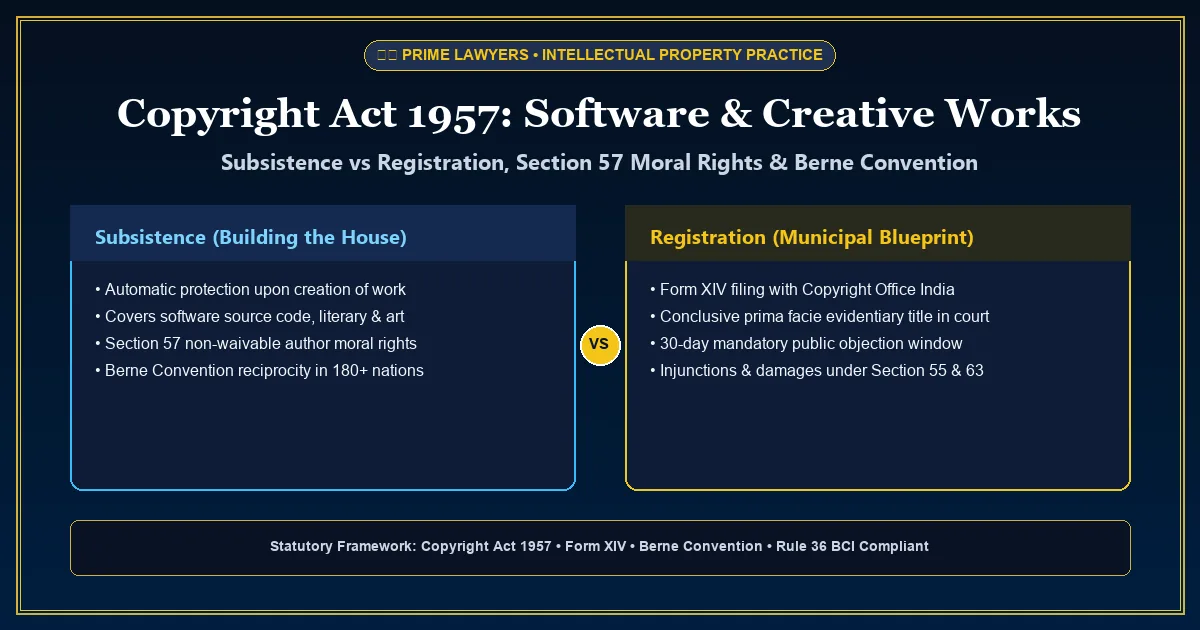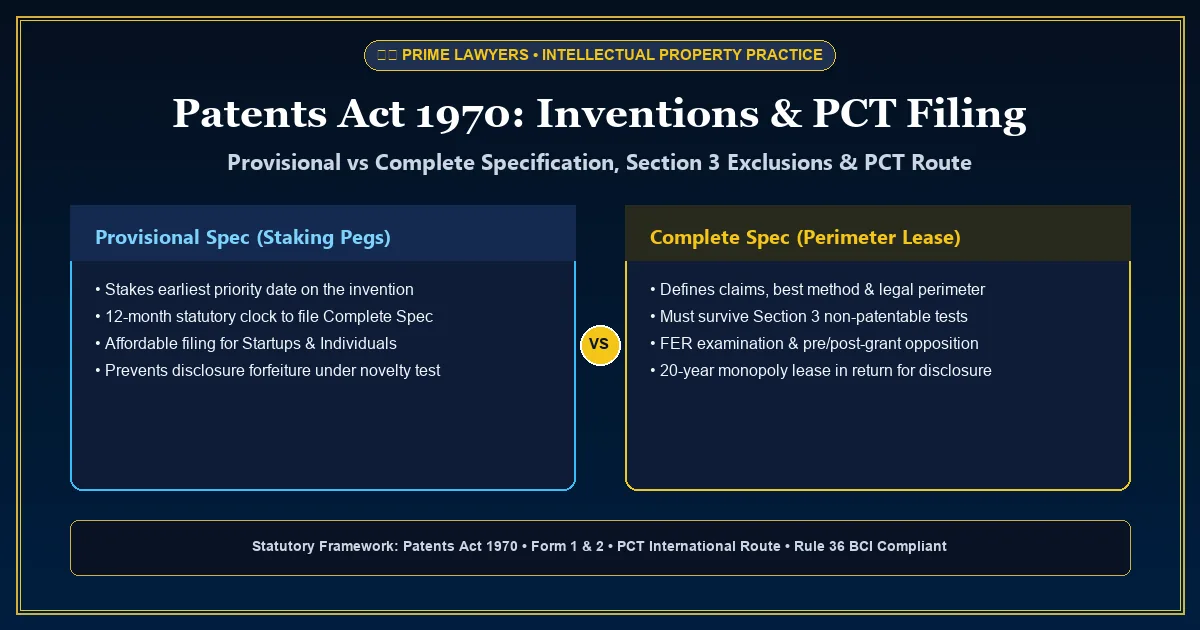
An authoritative statutory dissection of Indian trademark law: analysing the strict legal distinction between ™ and ®, Section 107 criminal sanctions for premature ® use, Form TM-A electronic filing, MSME statutory fee concessions, Section 9 absolute vs Section 11 relative examination replies, and the WIPO Madrid Protocol international protection gateway.
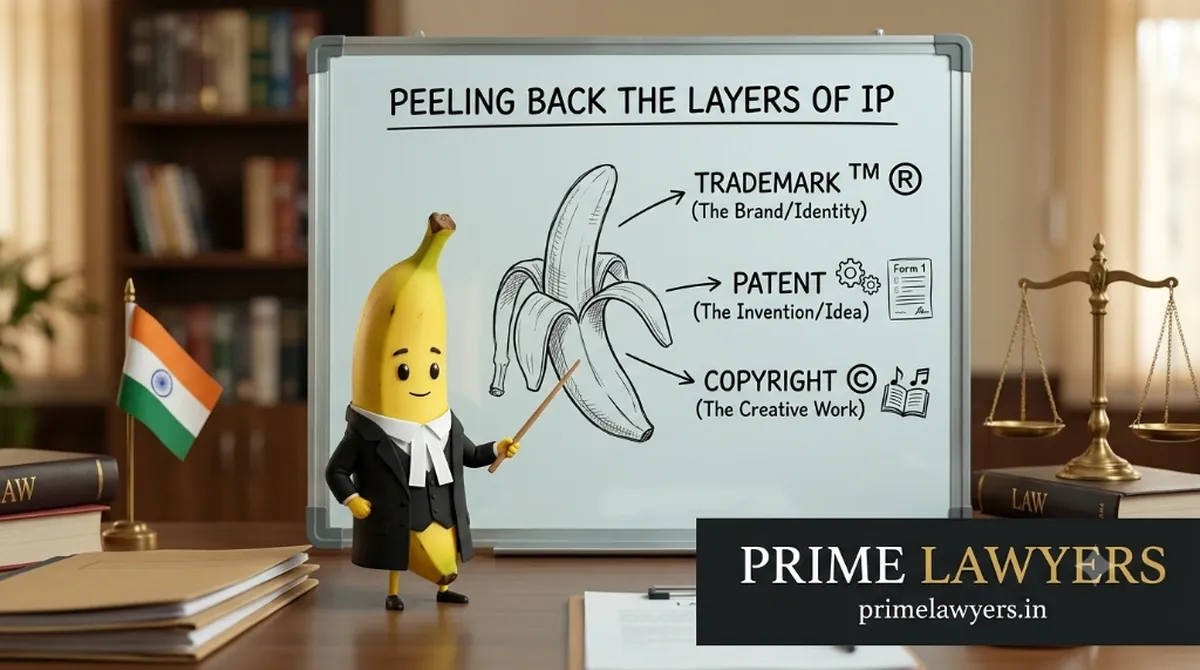
To the commercial entrepreneur or startup founder, Indian Intellectual Property (IP) jurisprudence frequently presents itself as an impenetrable fortress of statutory codes, conflicting judicial doctrines, and labyrinthine registry forms. However, intellectual property protection becomes crystal clear when viewed through its structural anatomy: exactly like peeling a banana, effective IP strategy requires peeling back the distinct regulatory layers that safeguard enterprise value.
In the visual jurisprudence illustrated above, each primary legal discipline occupies a sovereign domain:
The central figure in our pedagogical illustration—the Nano-Banana Advocate—embodies one of the most celebrated doctrines in global trademark jurisprudence: the Arbitrary Mark. When a common agricultural product name (such as "Apple" or "Banana") is appropriated for an entirely unrelated commercial sector (such as personal computers or legal advisory services), it achieves the highest echelon of statutory distinctiveness. Because there is zero descriptive nexus between a banana and legal advisory, the mark cannot be claimed by competitors as a necessary commercial description, securing impregnable judicial protection.
A widespread and hazardous misconception among Indian businesses is the belief that filing an application on Form TM-A entitles the applicant to immediately brandish the registered symbol ®. Under Indian statutory law, this assumption is not merely incorrect—it is a criminal offence.
Under Section 107(1), any person who makes any representation with respect to a mark not being a registered trade mark, to the effect that it is a registered trade mark (specifically including the use of the word "registered" or the symbol "®"), shall be punishable with imprisonment for a term which may extend to three years, or with fine, or with both.
The precise statutory boundaries are structured as follows:
| Feature | ™ Symbol (Trade Mark) | ® Symbol (Registered) |
|---|---|---|
| Legal Nature | Notice of proprietary claim; common-law adoption indicator. | Statutory title deed issued under sovereign seal. |
| Permissible Timing | Usable immediately upon adopting the mark or filing Form TM-A. | Permissible only after issuance of the Registration Certificate. |
| Statutory Remedy | Common Law action for Passing Off (requires proving goodwill and damage). | Statutory action for Infringement under Section 29 (strict liability). |
| Premature Use Consequence | None. It merely serves as public notice of claimed usage. | Criminal prosecution under Section 107 (up to 3 years imprisonment). |
Indian courts, adopting the authoritative jurisprudence established in Abercrombie & Fitch Co. v. Hunting World, Inc. (537 F.2d 4) and affirmed by the Supreme Court of India in cases such as Cadila Health Care Ltd. v. Cadila Pharmaceuticals Ltd. ((2001) 5 SCC 73), evaluate trademark strength across five distinct categories:
Strategic Counsel Note: Startups frequently fall into the trap of choosing descriptive names to save on marketing expenses. However, this creates insurmountable obstacles before the Trade Marks Registry. Choosing an arbitrary or coined mark ensures seamless passage through Section 9 scrutiny and enables decisive *ex parte* [in the absence of the other party] injunctions in court against prospective copycats.
The registration of a trade mark in India is governed by the Trade Marks Act, 1999 and the Trade Marks Rules, 2017. The administrative workflow administered by the Controller General of Patents, Designs and Trade Marks (CGPDTM) proceeds through six statutory stages:
Prior to filing, an exhaustive electronic search of the official IP India Trade Marks Database is indispensable across the relevant international Nice Class (Classes 1 to 34 for goods; Classes 35 to 45 for services). The search must encompass:
Application is lodged electronically on the IP India e-filing gateway via Form TM-A. Under the amended First Schedule to the Trade Marks Rules, 2017:
To claim the 50% statutory fee waiver, an enterprise must upload its valid Udyam Registration Certificate or DPIIT Recognition Certificate alongside the filing. Upon submission, an official filing receipt containing the application number is generated immediately, entitling the applicant to use the ™ symbol.
If the mark contains a device or visual logo, the Registry's internal classification unit assigns a Vienna Code. If basic procedural defects exist (such as an incorrect user affidavit, missing power of attorney, or ambiguous description of goods), the status updates to "Formality Check Fail", requiring a compliance petition within 30 days.
Following formal verification, the application undergoes substantive examination by an Examiner of Trade Marks. If statutory hurdles exist, an official Examination Report is issued, raising objections under Section 9, Section 11, or both.
Concerns the inherent nature of the mark itself:
Concerns conflict with existing third-party marks on the register:
The 30-Day Reply Window: Under Rule 33 of the Trade Marks Rules, 2017, the applicant must file a detailed statutory reply to the Examination Report within one month (30 days) of receipt. If the Examiner remains unpersuaded by the written submission, a Show Cause Hearing is scheduled before the Hearing Officer.
When the Examiner or Hearing Officer is satisfied that the mark complies with statutory requirements, the mark is ordered to be "Advertised before Acceptance" or "Accepted and Advertised" in the official Trade Marks Journal, published every Monday by the Trade Marks Registry.
The Statutory 4-Month Opposition Window: Under Section 21 of the Trade Marks Act, 1999, any person—regardless of whether they have a proprietary interest—may file a formal Notice of Opposition on Form TM-O within four months from the date of the Journal publication. This 4-month statutory deadline is rigid and cannot be extended by the Registrar.
If an opposition is lodged, adversarial proceedings commence, involving Counter-Statement (Form TM-O within 2 months), Evidence in Support of Opposition (Rule 45), Evidence in Support of Application (Rule 46), and a final oral hearing. If no opposition is filed within four months, or if the opposition is dismissed, the Registry formally issues the Registration Certificate under Section 23.
The Moment of ®: Only when the digital Registration Certificate bearing the National Emblem is generated and entered into the Register of Trade Marks may the owner legally replace the ™ symbol with the registered ® symbol. Trademark registration is valid for 10 years from the date of application and is renewable indefinitely every 10 years via Form TM-R.
For commercial clients and startup founders, the complexities of trademark law become immediately intuitive when mapped directly to Real Estate and Immovable Property Conveyancing:
When you invent a brand name and put ™ on your product packaging or website, it is identical to discovering an open piece of land, erecting a temporary wooden fence around it, and nailing a hand-painted wooden sign board that says: "Caution: Occupied Plot. Private Property." It alerts neighbours and competitors that you claim possession, but you do not yet possess an official government title deed.
Submitting Form TM-A on the IP India portal is submitting your land survey blueprints to the municipal Revenue Tehsildar for formal mutation. The government assigns you a diary file number (Application Number) and checks if your claimed boundary coordinates overlap anyone else's surveyed estate.
A Section 9 objection is the government revenue officer declaring: "You cannot fence this land; it is a public village thoroughfare or common pasture (generic/descriptive)." You must prove that through decades of continuous farming, this specific plot has transformed into your exclusive farmstead. A Section 11 objection is the officer warning: "Your northern boundary fence encroaches directly upon Sharma's pre-registered survey deed." You must prove Sharma's deed lies in an entirely different village sector (different goods/market).
Obtaining the Section 23 Registration Certificate is the Sub-Registrar handing you the registered, embossed property title deed. You can now take down the temporary wooden fence and carve ® into the stone pillars. If an encroacher steps on your land, you do not have to prove how long you have lived there; you simply present the registered deed in court for an immediate summary eviction order.
Rather than traveling to 50 foreign countries to hire 50 different local property deed agents, the Madrid Protocol functions as a master international property registry passport. By producing your Indian title deed, you instruct the central Geneva office to stamp and record your property ownership across global jurisdictions in one unified transaction.
India acceded to the Madrid Protocol Relating to the Madrid Agreement Concerning the International Registration of Marks on April 8, 2013, with the treaty coming into operational effect on July 8, 2013. The Madrid Protocol system is administered centrally by the International Bureau of the World Intellectual Property Organization (WIPO) located in Geneva, Switzerland.
Prior to the Madrid Protocol, an Indian enterprise seeking global protection was compelled to file separate national trademark applications in every single jurisdiction (e.g., USPTO in the USA, EUIPO in Europe, UKIPO in the United Kingdom, UAE Ministry of Economy). This necessitated hiring separate local attorneys, paying in multiple foreign currencies, and managing chaotic, asynchronous renewal dates.
Under Article 6 of the Madrid Protocol, the international registration remains dependent upon the basic Indian application/registration for a period of five years from the date of international registration. If the basic Indian application is refused, abandoned, withdrawn, or cancelled within this 5-year window, the international registration is automatically cancelled in all designated foreign countries (known as a "Central Attack"). However, the Madrid Protocol provides a "transformation" mechanism allowing the applicant to convert the canceled international rights into separate national filings while retaining the original priority date.
In strict compliance with regulatory disclosures, the official statutory government filing fees prescribed under the First Schedule of the Trade Marks Rules, 2017 are set forth below (excluding professional drafting or attorney representation):
| Statutory Form | Purpose & Description | Individual / Startup / MSME Fee (E-filing) | Large Enterprise / Other Entity Fee (E-filing) |
|---|---|---|---|
| Form TM-A | Application for registration of a trademark (per class). | ₹4,500 | ₹9,000 |
| Form TM-M | Miscellaneous request (clerical amendment, extension, adjournment). | ₹900 | ₹1,800 |
| Form TM-O | Notice of Opposition to an advertised mark in the Journal. | ₹2,700 | ₹5,400 |
| Form TM-R | Renewal of registration for a 10-year period (per class). | ₹9,000 | ₹9,000 |
| Form IA-1 / MM2(E) | Indian Registry certification fee for Madrid Protocol filing. | ₹2,000 | ₹2,000 |
Note: Physical paper filings incur a 10% statutory surcharge across all forms. Electronic filing via the official IP India gateway is highly recommended. International fees payable to WIPO under the Madrid Protocol are calculated in Swiss Francs (CHF) based on designated countries.
No. Under Section 107 of the Trade Marks Act, 1999, representing an unregistered or pending trade mark as registered using the ® symbol is a punishable criminal offence carrying imprisonment of up to 3 years and/or a substantial fine. You may only use the ™ symbol while your application is pending examination, advertisement, or opposition proceedings. The ® symbol is strictly reserved for marks that have received the official Registration Certificate issued under Section 23.
Under the Trade Marks Rules, 2017, the official statutory government e-filing fee for Form TM-A is ₹4,500 per class for Individuals, DPIIT-recognised Startups, and MSMEs holding a valid Udyam Registration Certificate. In contrast, large corporate entities without MSME status must pay the full statutory government fee of ₹9,000 per class. This represents an immediate 50% statutory government concession to foster domestic innovation.
Section 9 concerns Absolute Grounds of Refusal, objecting to marks that are devoid of distinctive character, purely descriptive of goods/services, generic, or common in trade. Section 11 concerns Relative Grounds of Refusal, objecting when the mark is identical or deceptively similar to an earlier existing registered trademark or pending application in the same or similar class, creating a likelihood of confusion among the purchasing public.
Once an application passes examination, it is advertised in the official weekly Trade Marks Journal. Under Section 21 of the Trade Marks Act, 1999, third parties have a strict, non-extendable statutory window of 4 months to file a formal Notice of Opposition on Form TM-O. If no opposition is filed or if opposition proceedings are decided in favor of the applicant, the Registry enters the mark into the Register and issues the Registration Certificate under Section 23.
Administered by WIPO in Geneva, the Madrid Protocol allows Indian brand owners with a basic domestic application or registration to file a single international application (Form MM2(E)) via the Indian Trade Marks Registry, designating up to 130+ contracting member countries. It provides centralised management, a single filing currency (Swiss Francs - CHF), and uniform 10-year renewal cycles without having to manage separate foreign filings in each country.
Under the Abercrombie spectrum of distinctiveness, arbitrary marks use real dictionary words that possess zero logical or descriptive connection to the underlying product or service (e.g., Apple for computers or Banana for legal advisory). Because they do not describe the product's attributes, they enjoy inherent distinctiveness and the highest degree of judicial protection against third-party infringement from day one.
Prime Lawyers collaborates with domestic enterprises, DPIIT-recognised technology startups, and international law firms seeking Indian jurisdictional representation, Madrid Protocol origin filings, PCT national phase prosecution, and High Court intellectual property litigation. In strict compliance with Bar Council of India Rule 36, all professional affiliations operate on non-solicitation, mutual professional respect, and legal academic integrity.