

1. The Constitutional Shield Against Planning Overreach
Urban planning authorities frequently operate under the assumption that municipal regulations enjoy an unconstrained primacy over private rights. Constitutional jurisprudence in India establishes precisely the reverse: every planning regulation, master plan restriction, and building bye-law must subordinate itself to the Constitution of India.
When municipal bodies and development authorities exercise regulatory power over citizen homes, their actions intersect with three vital constitutional guarantees:
- Article 14: Guarantees equality before the law and protection against administrative arbitrariness. In E.P. Royappa v. State of Tamil Nadu (1974) 4 SCC 3 and Maneka Gandhi v. Union of India (1978) 1 SCC 248, the Supreme Court established that arbitrariness is antithetical to the Rule of Law. An administrative order that is selective, whimsical, or disproportionately punitive violates Article 14.
- Article 21: Guarantees the right to life and personal liberty, which includes the Right to Dignified Shelter. In Shantistar Builders v. Narayan Khimalal Totame (1990) 1 SCC 520 and Chameli Singh v. State of U.P. (1996) 2 SCC 549, the Supreme Court ruled that shelter for a human being is not mere animal existence, but an essential component of the right to life.
- Article 300A: Mandates that "no person shall be deprived of his property save by authority of law."
⚖️ Constitutional Equilibrium in Chandigarh: Balancing Urban Planning with Citizen Rights
Systemic comparison between administrative overreach and constitutional mandates, illustrating why municipal planning must accommodate human dignity, shelter rights, and statutory compounding.
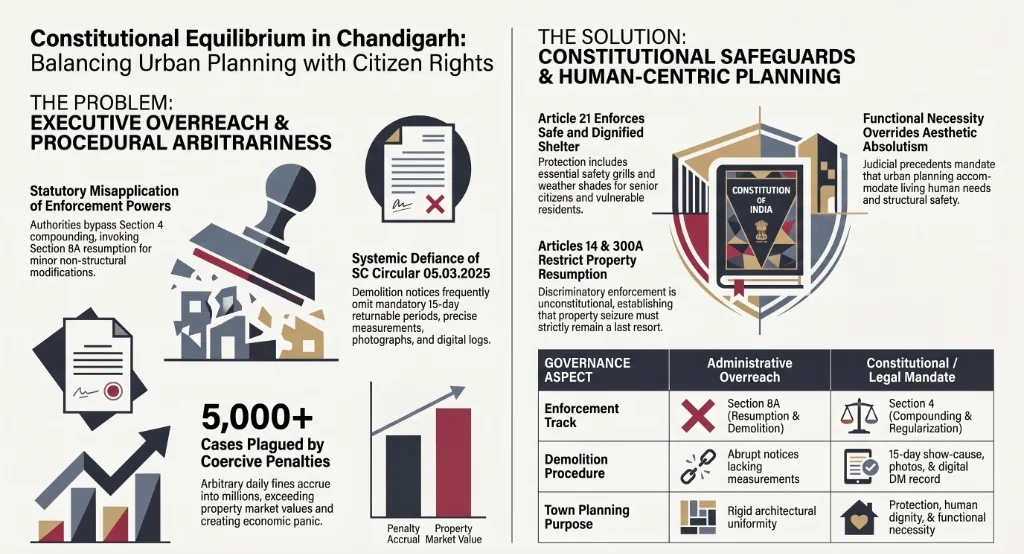
Statutory Misapplication: Authorities frequently bypass Section 4 compounding mechanisms, directly invoking draconian Section 8-A resumption and demolition for minor non-structural modifications.
Systemic Procedural Defiance: Demolition notices repeatedly omit mandatory 15-day returnable periods, precise architectural measurements, spot memos, and digital logs.
5,000+ Cases Plagued: Arbitrary daily fines accrue into millions of rupees, exceeding total property market values and triggering severe economic distress.
Article 21 (Safe & Dignified Shelter): Constitutional protection includes essential safety grills, weather sunshades, and elevator access for senior citizens and vulnerable residents.
Articles 14 & 300A (Restricting Property Seizure): Discriminatory or selective enforcement is unconstitutional; property resumption must strictly remain a weapon of last resort.
Functional Necessity: Established judicial precedent mandates that urban planning must subordinate aesthetic absolutism to living human necessities and structural safety.
🏛️ Governance Aspect Comparison Matrix
| Governance Aspect | Administrative Overreach (Flawed Practice) | Constitutional / Legal Mandate |
|---|---|---|
| Enforcement Track | ❌ Immediate Section 8A Resumption & Demolition | ⚖️ Section 4 Compounding & Rule 19 Regularisation |
| Demolition Procedure | ❌ Abrupt notices lacking measurements & photos | 📑 Mandatory 15-day show-cause, photos, & hearing minutes |
| Town Planning Purpose | ❌ Rigid architectural uniformity at citizen expense | 🏡 Human dignity, life protection, & functional necessity |
2. Article 300A: From Fundamental Right to Human Right
The 44th Constitutional Amendment (1978) omitted Article 19(1)(f) and Article 31 from Part III, inserting Article 300A into Chapter IV of Part XII. While property ceased to be a Fundamental Right, contemporary Supreme Court jurisprudence has elevated Article 300A into an inviolable constitutional and human right.
In Hari Krishna Mandir Trust v. State of Maharashtra (2020) 9 SCC 356, the Supreme Court held:
"Though the right to property is no longer a fundamental right, it is still a constitutional right under Article 300-A and also a human right... The State cannot dispossess a citizen of his property without following the procedure established by law."
In Vidya Devi v. State of Himachal Pradesh (2020) 2 SCC 569, reaffirmed in B.K. Ravichandra v. Union of India (2021) 14 SCC 703, the Apex Court observed that in a democratic polity governed by the Rule of Law, the State cannot be permitted to act as a land-grabber or dispossess citizens without statutory authority and fair compensation.
3. What Constitutes 'Authority of Law' Under Article 300A?
The central guarantee of Article 300A is that deprivation can only occur by "authority of law". The Supreme Court has repeatedly clarified what this phrase demands:
- Primary Legislation Required: The word "law" denotes a valid legislative enactment passed by a competent legislature or rules made thereunder. Mere executive circulars, administrative guidelines, or unnotified draft policies do not constitute "law" for the deprivation of property (Bishan Das v. State of Punjab, AIR 1961 SC 1570).
- Just, Fair, and Reasonable Law: The law authorizing deprivation must satisfy the tests of Articles 14 and 21. It cannot be arbitrary, oppressive, or unguided.
- Constructive Confiscation: When an authority imposes restrictions that completely destroy the economic utility or peaceful residential enjoyment of a property without acquiring it, such action amounts to "constructive confiscation" and violates Article 300A.
4. Steelman Analysis: Zoning Discipline vs. Property Rights
🏛️ The Legitimate Need for Urban Zoning Regulations
Zoning controls, Floor Area Ratio (FAR) ceilings, and setback rules are essential police powers of the State. An owner cannot claim that Article 300A grants them an absolute right to build whatever they desire without municipal sanction. Unchecked building density directly harms neighbours' light, privacy, and municipal fire safety.
The constitutional synthesis is that while regulatory restrictions on land use are valid, they must be proportionate, reasonable, and non-confiscatory. An authority cannot use a minor deviation (such as a 2-foot sunshade or an elderly person's elevator) as a pretext to resume the entire plot or dispossess an owner who has paid the complete consideration.
5. Constitutional Safeguards Checklist for Property Owners
When an administrative authority threatens property rights or issues resumption notices, evaluate these constitutional checkpoints:
-
Statutory Sanction: Is the threatened deprivation backed by an express statutory section (e.g. Sec. 8-A of 1952 Act) or merely an unnotified office order?
-
Title and Freehold Status: Is the property leasehold or freehold? (Resumption of freehold property faces far stricter constitutional hurdles).
-
Least Restrictive Means: Did the authority consider compounding fees, structural rectification, or monetary penalty before threatening resumption?
-
Non-Discrimination Proof: Collate photographic evidence and sanction orders of similar properties in the sector that were granted compounding.
Chambers Collegial Forum: Subject Consultation & Public Pain Research for Legal Practitioners
Under the framework of professional fraternity and civic jurisprudence, our Chambers actively welcomes practicing advocates, Bar Association colleagues, researchers, and public policy scholars seeking subject-matter consultation, technical statutory interpretation, or collaborative academic analysis on Constitutional Property Rights & Article 300A Planning Limits.
🔍 Probing the Ground Realities ("The True Pain of the Public"):
Decades of rigid building bye-laws, retrospective resumption notices, non-speaking administrative rejections, and bureaucratic delays have created acute, unredressed distress for thousands of law-abiding property owners, elderly citizens, and middle-class families in Chandigarh. We regularly exchange technical legal notes, procedural precedent, and empirical documentation with fellow members of the Bar to assist them in formulating rigorous, evidence-based challenges before statutory appellate authorities and the High Court of Punjab & Haryana.
Statutory Notice: In accordance with Bar Council of India regulations, this forum is strictly non-solicitation and serves exclusively for professional discourse, legal scholarship, and academic analysis.
6. Frequently Asked Questions
Can the Chandigarh Administration cancel an allotment decades after completion of construction?
Resumption after decades of peaceful occupation is heavily scrutinized by constitutional courts. Under the doctrine of laches and legitimate expectation, and applying the proportionality ratio of Teri Oat Estates (2004), courts have held that an authority cannot act oppressively after sitting idle for decades, especially when the deviation is compoundable.
Does the Right to Shelter under Article 21 protect senior citizens who install elevators in housing board units?
Yes. In multiple writ petitions, High Courts have recognized that need-based adaptations such as lift installations for senior citizens and disabled residents fall within the penumbra of the Right to Dignified Life under Article 21, subject to certified structural stability.