
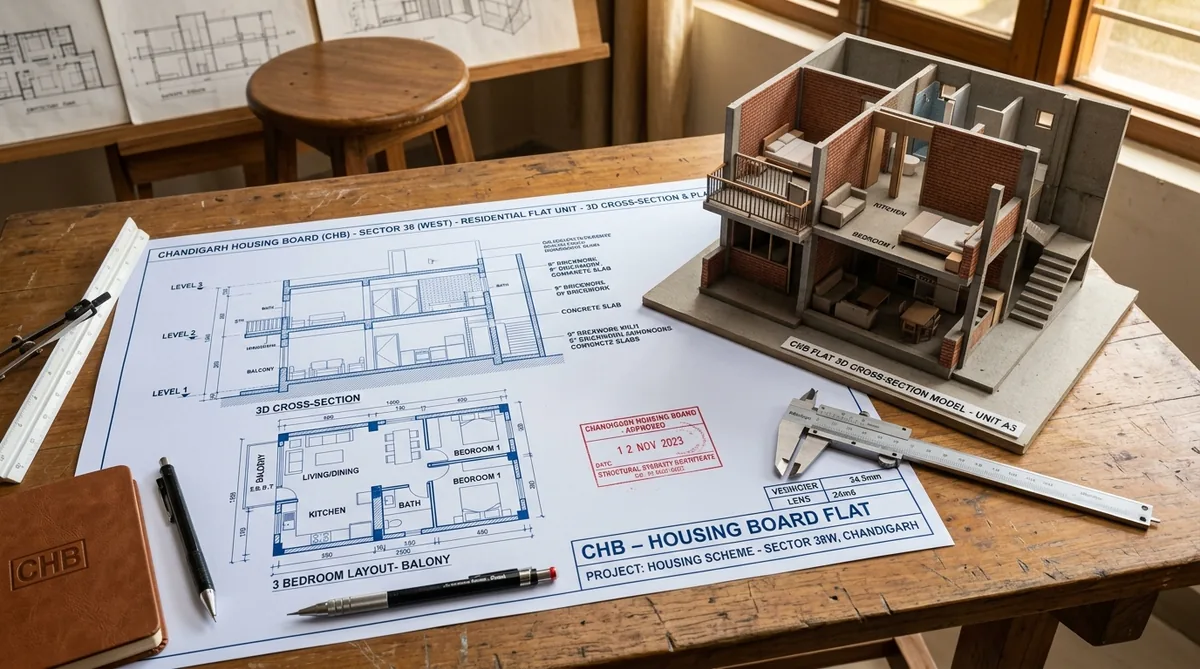
1. The Need-Based Alterations Dilemma in Chandigarh
Over 60,000 families in Chandigarh reside in dwelling units constructed by the Chandigarh Housing Board (CHB) across Sectors 38, 40, 44, 45, 47, 56, and modern rehabilitation sectors. Designed during the 1970s and 1980s for small families under rigid architectural typologies, these compact flats quickly proved inadequate as families grew over decades.
To accommodate growing children, aging parents, and personal privacy, residents carried out essential, need-based alterations: enclosing balconies, removing non-load-bearing internal partitions, constructing sunshades, and adding safety grills. However, the CHB routinely treated these minor adaptations as "grave building violations," issuing thousands of cancellation, demolition, and resumption notices.
Following sustained citizen representations and judicial interventions, the Chandigarh Administration promulgated a structured framework to compound and regularise these alterations.
📊 Chandigarh Building Violations: A Citizen’s Guide to Rights & Rules
Essential visual guide and statutory breakdown of constitutional defenses, procedural safeguards under official circulars, and rationalized penalty rate structures.
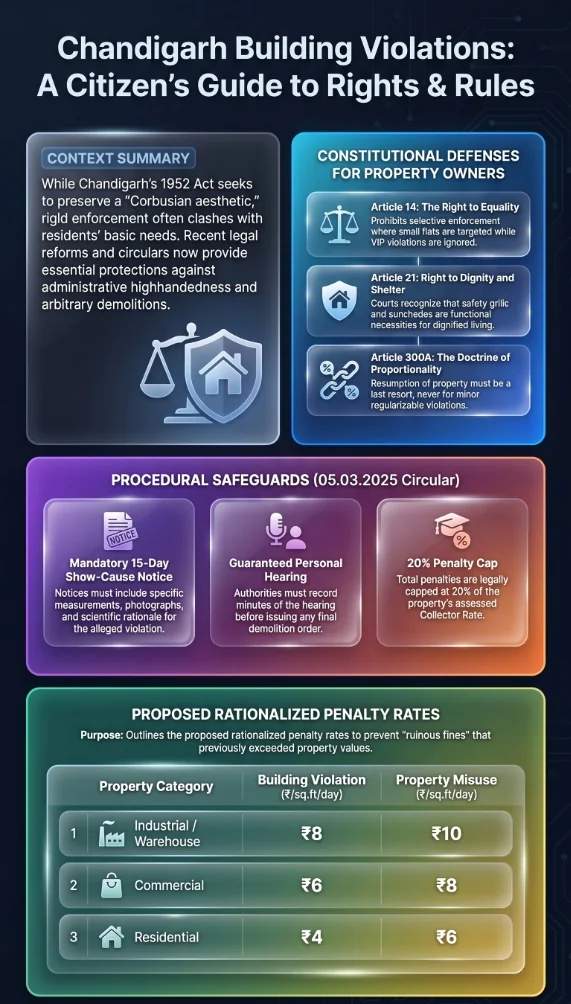
While Chandigarh's 1952 Act seeks to preserve a "Corbusian aesthetic," rigid enforcement often clashes with residents' basic human needs. Recent legal reforms, judicial directions, and administrative circulars now provide essential protections against administrative highhandedness and arbitrary demolitions.
Article 14 (Right to Equality): Prohibits selective enforcement where small dwelling units are targeted while influential commercial violations are overlooked.
Article 21 (Dignity & Shelter): Courts recognize that safety grills, sunshades, and elderly lifts are functional necessities for dignified living.
Article 300A (Proportionality): Resumption of property is an extreme sanction of last resort, never permissible for minor, regularizable deviations.
🛡️ Procedural Safeguards Mandated by Law
Mandatory 15-day prior notice returnable window. Notices must include precise measurements, photographs, and scientific rationale for the alleged violation.
Guaranteed opportunity of being heard. Authorities must record written minutes of the hearing before issuing any final demolition or resumption order.
Total statutory penalties are legally capped at 20% of the property's assessed Collector Rate to prevent ruinous, confiscatory fines.
🏷️ Proposed Rationalized Penalty Rates (To Prevent Economic Waste)
| # | Property Category | Building Violation Rate | Property Misuse Rate |
|---|---|---|---|
| 1 | 🏭 Industrial / Warehouse | ₹8 / sq.ft / day | ₹10 / sq.ft / day |
| 2 | 🛍️ Commercial | ₹6 / sq.ft / day | ₹8 / sq.ft / day |
| 3 | 🏡 Residential | ₹4 / sq.ft / day | ₹6 / sq.ft / day |
🇮🇳 चंडीगढ़ भवन नियम: प्रशासनिक मनमानी बनाम आपके संवैधानिक अधिकार
नागरिकों की सुरक्षा के लिए सरल हिंदी में विधिक सुरक्षा कवच, तोड़फोड़ से पूर्व अनिवार्य 15-दिवसीय नोटिस, और आवश्यकता-आधारित परिवर्तनों के लिए निर्धारित नियमितीकरण शुल्क।
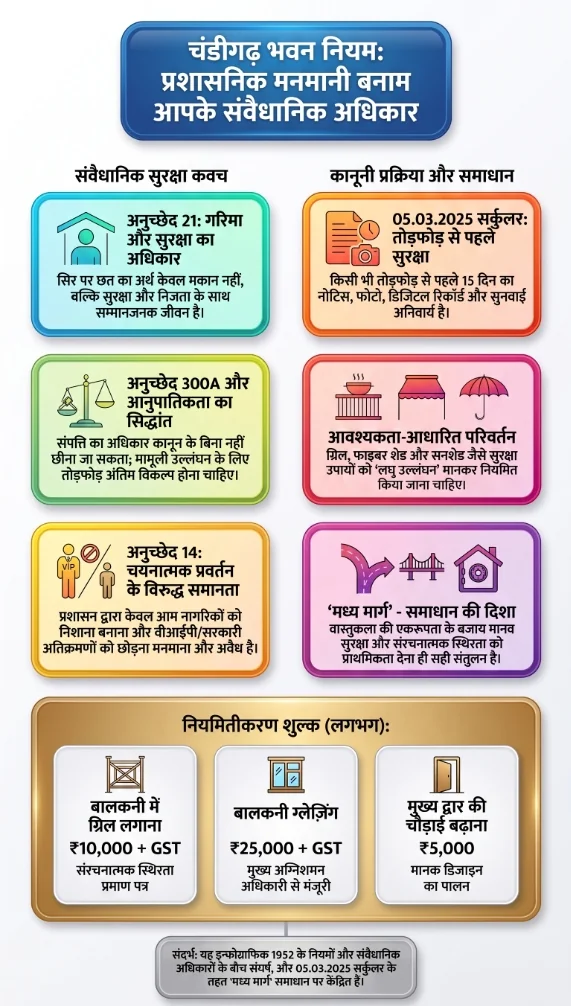
अनुच्छेद 21 (गरिमा और सुरक्षा का अधिकार): सिर पर छत का अर्थ केवल मकान नहीं, बल्कि सुरक्षा, स्वास्थ्य और निजता के साथ सम्मानजनक जीवन है।
अनुच्छेद 300A (आनुपातिकता का सिद्धांत): संपत्ति का अधिकार कानून के अधिकार के बिना नहीं छीना जा सकता; मामूली उल्लंघन के लिए तोड़फोड़ अंतिम विकल्प होना चाहिए।
अनुच्छेद 14 (चयनात्मक प्रवर्तन के विरुद्ध समानता): प्रशासन द्वारा केवल आम नागरिकों को निशाना बनाना और वीआईपी/सरकारी अतिक्रमणों को छोड़ना मनमाना और अवैध है।
तोड़फोड़ से पहले सुरक्षा: किसी भी तोड़फोड़ या सीलिंग से पहले 15 दिन का कारण बताओ नोटिस, स्पष्ट फोटो, डिजिटल माप रिकॉर्ड और सुनवाई का अवसर अनिवार्य है।
आवश्यकता-आधारित परिवर्तन: ग्रिल, फाइबर शेड और सनशेड जैसे सुरक्षा उपायों को 'लघु व शमनीय उल्लंघन' मानकर नियमित किया जाना चाहिए।
'मध्य मार्ग' - समाधान की दिशा: वास्तुकला की एकरूपता के बजाय मानव सुरक्षा, वरिष्ठ नागरिकों की सुगमता और संरचनात्मक स्थिरता को प्राथमिकता देना ही वास्तविक न्याय है।
💵 नियमितीकरण शुल्क संरचना (CHB Need-Based Regularisation Rates)
₹10,000 + GST
शर्त: पंजीकृत संरचनात्मक इंजीनियर से संरचनात्मक स्थिरता प्रमाण पत्र।
₹25,000 + GST
शर्त: मुख्य अग्निशमन अधिकारी (Fire Department) से अनापत्ति और मानक ड्राइंग।
₹5,000
शर्त: मानक डिज़ाइन और बिना कॉलम काटे सुरक्षित विस्तार।
2. Primary Source Verification: Orders, SOP & Stability Proforma
All guidance on this page is directly verifiable from primary administrative sources published on the official CHB digital portal:
| Administrative Instrument | Date & Details | Official Verification Source |
|---|---|---|
| CHB Order No. 02 | Order No. 02 dt. 03.01.2023 laying down permissible need-based alterations in CHB flats. | CHB Need-Based Implementation Portal ↗ |
| Implementation Order 2026 | Order dt. 10.03.2026 governing active procedural execution of the need-based framework. | Download Implementation Order (PDF) ↗ |
| Standard Operating Procedure (SOP) | Detailed step-by-step procedure for processing and approving regularisation applications. | Download CHB 2026 SOP Document (PDF) ↗ |
| Structural Stability Proforma | Mandatory certificate proforma from registered structural engineers certifying building safety. | Download Structural Stability Proforma (PDF) ↗ |
3. Compoundable vs. Non-Compoundable Alterations
The 2026 SOP establishes a clear demarcation between changes that can be regularised upon payment of compounding fees and those considered structural hazards:
| Permissible & Compoundable Changes | Strictly Prohibited / Non-Compoundable |
|---|---|
| ✔ Enclosure of rear/front balconies within the building line using lightweight glazing/materials. | ❌ Encroachment upon public land, government corridors, or green belts outside boundary lines. |
| ✔ Internal partition wall adjustments (non-load-bearing 4.5" walls) for modern room division. | ❌ Tampering with or cutting reinforced concrete (RCC) columns, beams, or shear walls. |
| ✔ Installation of external elevators/lifts for upper floors with structural certification and mutual consent. | ❌ Construction of unauthorized additional storeys beyond the sanctioned floor count. |
| ✔ Cantilevered sunshades, chhajjas, and safety grills conforming to fire egress rules. | ❌ Blocking common staircases, fire escapes, or building light and ventilation shafts. |
| ✔ Coverage of internal courtyards with lightweight translucent fiber sheets for rain protection. | ❌ Commercial misuse of residential ground-floor units in violation of zoning norms. |
4. Step-by-Step Regularisation Application Protocol
To secure regularisation under the 2026 SOP and obtain immunity against demolition or resumption notices, allottees must follow this 5-step sequence:
-
Architectural As-Built Survey: Engage an empanelled architect to prepare an exact 'as-built' drawing of the flat, showing existing sanctioned construction in black ink and additional need-based changes in red ink.
-
Structural Stability Certification: Have the alterations inspected by a structural engineer registered with the Chandigarh Administration, securing the signed certificate in the official Structural Stability Proforma.
-
Mutual NOC from Co-Allottees: For shared vertical stacks (e.g. four-storey flats), obtain the mutual consent affidavit from vertically adjacent allottees where common services or balconies are affected.
-
Fee Computation & Deposit: Calculate the compounding and scrutiny fee in terms of the rate chart specified in the 2026 SOP, depositing via official bank challan.
-
Online Portal Submission: Upload the complete dossier to the CHB online portal, obtaining a formal digital acknowledgment receipt for statutory record.
Chambers Collegial Forum: Subject Consultation & Public Pain Research for Legal Practitioners
Under the framework of professional fraternity and civic jurisprudence, our Chambers actively welcomes practicing advocates, Bar Association colleagues, researchers, and public policy scholars seeking subject-matter consultation, technical statutory interpretation, or collaborative academic analysis on Chandigarh Need-Based Building Alterations & CHB SOP 2026.
🔍 Probing the Ground Realities ("The True Pain of the Public"):
Decades of rigid building bye-laws, retrospective resumption notices, non-speaking administrative rejections, and bureaucratic delays have created acute, unredressed distress for thousands of law-abiding property owners, elderly citizens, and middle-class families in Chandigarh. We regularly exchange technical legal notes, procedural precedent, and empirical documentation with fellow members of the Bar to assist them in formulating rigorous, evidence-based challenges before statutory appellate authorities and the High Court of Punjab & Haryana.
Statutory Notice: In accordance with Bar Council of India regulations, this forum is strictly non-solicitation and serves exclusively for professional discourse, legal scholarship, and academic analysis.
5. Frequently Asked Questions
Can the CHB proceed with demolition while a regularisation application is pending?
No. Once a complete application complying with the 2026 SOP accompanied by structural certification and prescribed fees is submitted, administrative equity and natural justice require that the application be processed and decided by a speaking order before any coercive action can be initiated.
What recourse is available if an application is arbitrarily rejected without reasons?
A non-speaking rejection is vulnerable under the doctrine of procedural ultra vires and the ruling in Kranti Associates (2010). The affected allottee can file a statutory appeal or approach the High Court under Article 226 for a Writ of Mandamus directing a reasoned reconsideration.