
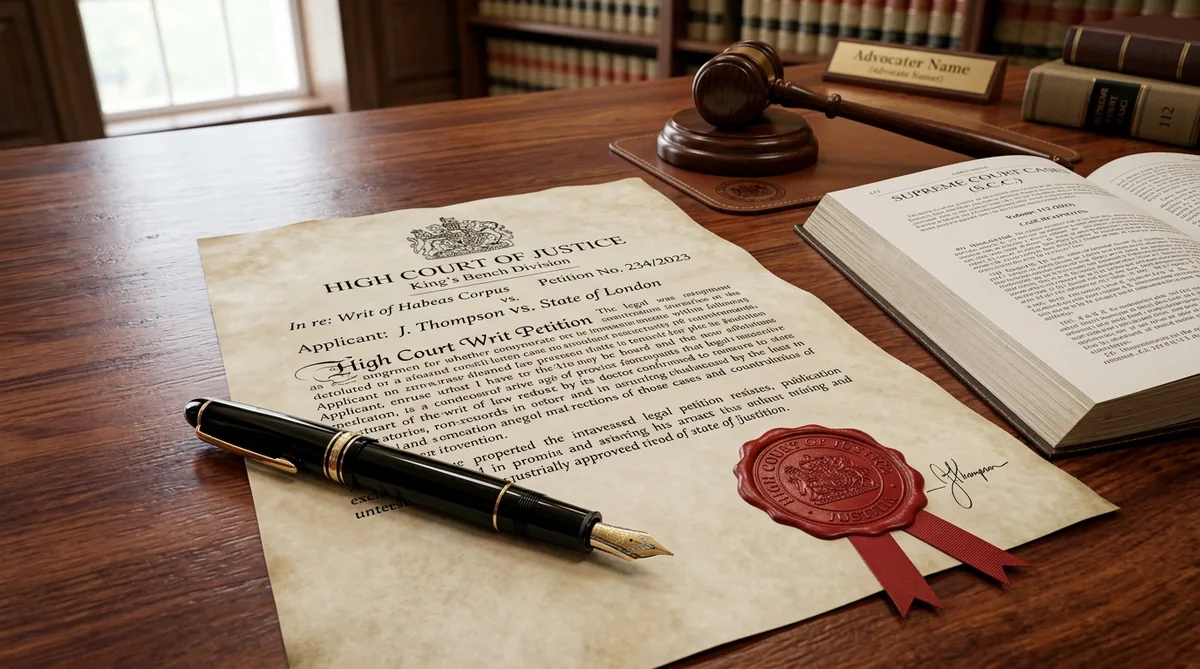
1. The Extraordinary Jurisdiction Under Article 226
The High Court of Punjab & Haryana exercises supervisory and extraordinary constitutional jurisdiction under Articles 226 and 227 of the Constitution of India. Unlike the Supreme Court's jurisdiction under Article 32, which is confined to the enforcement of Fundamental Rights, Article 226 empowers the High Court to issue prerogative writs "for the enforcement of any of the rights conferred by Part III and for any other purpose."
In property and administrative disputes involving the Chandigarh Administration, Municipal Corporation, or Housing Board, citizens primarily seek two prerogative writs:
- Writ of Certiorari: Issued to call for the records of an administrative or quasi-judicial authority and quash an order that suffers from patent lack of jurisdiction, procedural ultra vires, breach of natural justice, or an error of law apparent on the face of the record.
- Writ of Mandamus: Issued to command a public authority to perform a mandatory statutory duty that it has unlawfully refused or failed to perform (such as considering a compounding application or passing a speaking order).
2. Overcoming the Alternative Remedy Bar: The Whirlpool Ratio
A routine preliminary objection raised by government counsel in writ petitions against building notices is that the citizen has not exhausted statutory appeals under Section 10 or 11 of the Capital of Punjab Act, 1952. Constitutional law settles this issue emphatically.
In the locus classicus Whirlpool Corporation v. Registrar of Trade Marks (1998) 8 SCC 1, reaffirmed in Harbanslal Sahnia v. Indian Oil Corp. Ltd. (2003) 2 SCC 107 and Radha Krishan Industries v. State of H.P. (2021) 6 SCC 771, the Supreme Court laid down that the rule requiring exhaustion of alternative statutory remedies is a rule of self-restraint and judicial discretion, not a rule of jurisdiction.
The High Court will entertain an Article 226 writ petition directly in at least three established contingencies:
- Enforcement of Fundamental Rights: Where the impugned administrative action directly breaches Articles 14, 19, or 21 (such as arbitrary destruction of shelter).
- Violation of Natural Justice: Where the order was passed without issuing notice, without affording a reasonable opportunity of being heard, or by an officer who showed apparent bias.
- Total Lack of Jurisdiction / Ultra Vires: Where the proceedings or order are wholly without statutory jurisdiction, or the vires of an enabling Act, rule, or circular is challenged.
3. The Speaking Order Mandate: Kranti Associates Principles
One of the most persistent forms of executive arbitrariness in urban governance is the issuance of cryptic, one-line rejections: "Rejected as per rules" or "Violation confirmed, proceed with sealing."
In the seminal judgment Kranti Associates Pvt. Ltd. v. Masood Ahmed Khan (2010) 9 SCC 496, the Supreme Court consolidated decades of jurisprudence into a binding charter on speaking orders:
"Reasons are the links between the mind of the decision-maker to the controversy in question and the decision or conclusion arrived at. Reasons reveal a rational nexus between the facts considered and the conclusions reached. Recording of reasons is also an indispensable safeguard against arbitrary action and provides a check against bias or haste."
The Court held that an administrative order affecting civil rights that does not record reasons suffers from a patent error of law and must be quashed by the High Court.
4. Practical Drafting Checklist for High Court Writ Petitions
When drafting an Article 226 writ petition challenging building notices, sealing orders, or resumption proceedings before the Punjab & Haryana High Court, ensure the inclusion of these crucial pleadings:
-
Specific Jurisdiction Clause: Explicitly plead why the alternative remedy is bypassed (e.g., invoking the Whirlpool natural justice or jurisdictional defect exception).
-
Sanctioned Plan Chronology: Annex the original allotment letter, sanctioned building plan, and completion certificate to establish lawful root of title.
-
Proof of Notice Receipt: Annex the postal envelope or tracking report proving that the impugned order granted insufficient response time.
-
Tender of Willingness to Compound: State unambiguously on affidavit that the petitioner is ready and willing to compound all permissible alterations under the CHB SOP 2026.
-
Interim Relief Prayer: Specifically pray for an interim stay on dispossession, sealing, or demolition pending final adjudication, invoking Teri Oat Estates (2004).
Chambers Collegial Forum: Subject Consultation & Public Pain Research for Legal Practitioners
Under the framework of professional fraternity and civic jurisprudence, our Chambers actively welcomes practicing advocates, Bar Association colleagues, researchers, and public policy scholars seeking subject-matter consultation, technical statutory interpretation, or collaborative academic analysis on Article 226 High Court Writ Remedies & Speaking Orders.
🔍 Probing the Ground Realities ("The True Pain of the Public"):
Decades of rigid building bye-laws, retrospective resumption notices, non-speaking administrative rejections, and bureaucratic delays have created acute, unredressed distress for thousands of law-abiding property owners, elderly citizens, and middle-class families in Chandigarh. We regularly exchange technical legal notes, procedural precedent, and empirical documentation with fellow members of the Bar to assist them in formulating rigorous, evidence-based challenges before statutory appellate authorities and the High Court of Punjab & Haryana.
Statutory Notice: In accordance with Bar Council of India regulations, this forum is strictly non-solicitation and serves exclusively for professional discourse, legal scholarship, and academic analysis.
5. Frequently Asked Questions
Can the High Court grant an interim stay on demolition on the first date of hearing?
Yes. If the petitioner demonstrates a prima facie case of jurisdictional error or natural justice breach, that balance of convenience lies in their favor, and that irreparable injury (demolition of home) would occur without an injunction, the High Court routinely grants interim protection staying coercive steps.
What happens if an administrative authority ignores a High Court direction to pass a speaking order?
Wilful disobedience of an explicit High Court direction to decide a representation or pass a speaking order constitutes Civil Contempt under the Contempt of Courts Act, 1971, rendering the delinquent officer liable for contempt proceedings.