🔬 STATUTORY IP DISSECTION • PATENTS ACT, 1970 (ACT NO. 39 OF 1970)
Patent Filing in India: Provisional vs Complete Specification, Examination & PCT International Route
An authoritative statutory dissection of the Patents Act, 1970: analysing novelty, inventive step, and industrial applicability; Section 3 non-patentable exclusions and the Novartis anti-evergreening landmark; tactical provisional priority staking; claims drafting architecture; MSME fee waivers; and the WIPO PCT international prosecution route.
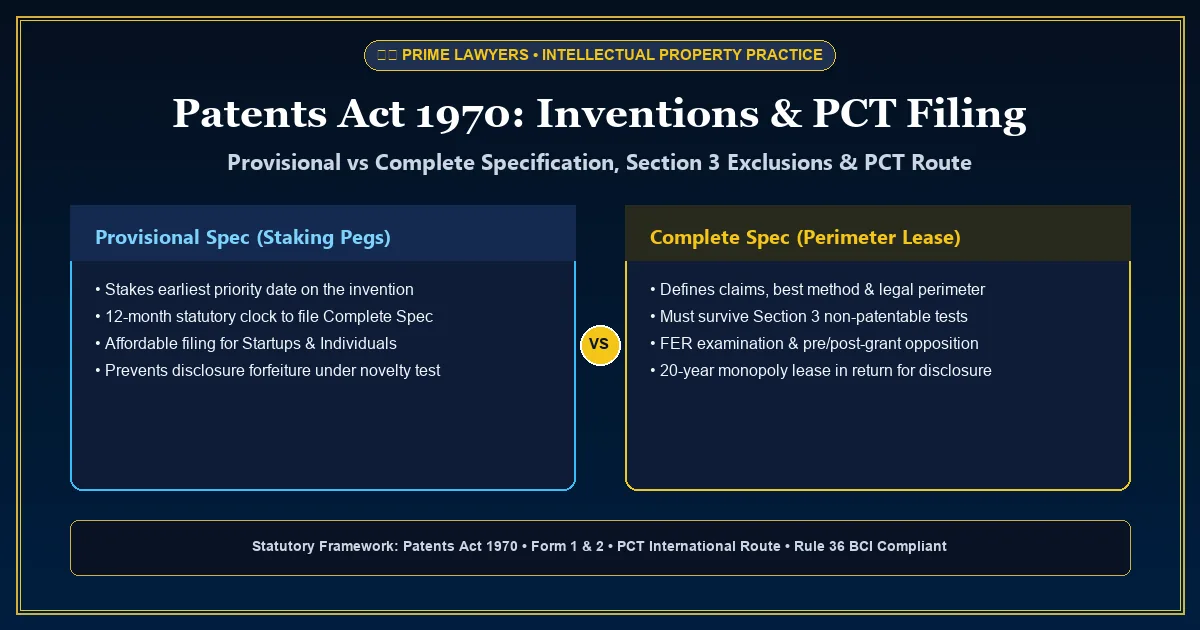
Figure 3: The statutory patent prosecution lifecycle in India: Tripartite patentability criteria, Form 1 & 2 provisional priority staking, Section 3 statutory exclusions, and PCT international filing.
⚡ EXECUTIVE CRUX CASCADE • STATUTORY HIGHLIGHTS
Tripartite Patentability Criteria: An invention must demonstrate absolute novelty worldwide, non-obvious inventive step (Section 2(1)(ja)), and industrial applicability (Section 2(1)(ac)).
Section 3 Statutory Exclusions: Section 3(d) strictly bars the patenting of new forms of known substances lacking enhanced therapeutic efficacy (*Novartis* precedent). Section 3(k) excludes computer programmes *per se* unless producing a concrete technical effect.
The Inflexible 12-Month Priority Clock: Filing a Provisional Specification (Form 2) locks in an immediate priority date. Under Section 9(1), a Complete Specification must be filed within precisely 12 months; failure results in irreversible abandonment with zero statutory extension.
80% MSME & Startup Statutory Fee Waiver: The official government e-filing fee for Form 1 & Form 2 is only ₹1,600 for Startups/MSMEs vs ₹8,000 for large companies. Examination fee (Form 18) is only ₹4,000 vs ₹20,000.
Examination Lifecycle: 18-month publication in Patent Office Journal; RFE within 31/48 months; First Examination Report (FER) reply within 6 months (+3 months extension on Form 4).
PCT International Gateway: An Indian PCT application delays foreign national phase expenses across 155+ nations for 30/31 months from priority.
1. The Tripartite Constitutional Charter of Patentability Under the Patents Act, 1970
A patent is the most potent and coercive monopoly conferred by sovereign authority: in exchange for full public disclosure of an invention's technological architecture, the State grants the patentee an exclusive, negative right for twenty years to exclude all third parties from making, using, offering for sale, selling, or importing the patented product or process within India.
Under Section 2(1)(j) of the Patents Act, 1970 (Act No. 39 of 1970), an invention means a new product or process involving an inventive step and capable of industrial application. To withstand rigorous scrutiny by the Indian Patent Office (IPO), an invention must satisfy three cumulative statutory pillars:
1. Novelty (Section 2(1)(l)): The invention must not have been anticipated by publication in any document, nor used in the country or elsewhere in the world, prior to the date of filing the patent application with complete specification. India enforces absolute novelty: any prior public display, research paper, YouTube demonstration, or commercial sale destroys novelty immediately.
2. Inventive Step / Non-Obviousness (Section 2(1)(ja)): A feature of an invention that involves technical advance as compared to existing knowledge or having economic significance or both, making the invention not obvious to a person skilled in the art (PSITA).
3. Industrial Applicability (Section 2(1)(ac)): The invention must be capable of being made or used in an industry, possessing practical utility beyond theoretical conjectures.
2. Non-Patentable Subject Matter: Section 3 Exclusions and the Novartis Precedent
Even if an invention is entirely novel, inventive, and industrially applicable, it will be summarily rejected if it falls under the negative statutory gate of Section 3 of the Patents Act, 1970 ("What are not inventions"). The most litigated statutory exclusions in Indian patent jurisprudence comprise:
Section 3(d): The Anti-Evergreening Shield & Novartis AG v. Union of India
Section 3(d) prohibits the patenting of "the mere discovery of a new form of a known substance which does not result in the enhancement of the known efficacy of that substance."
⚖️ The Landmark Ruling: Novartis AG v. Union of India ((2013) 6 SCC 1)
Swiss pharmaceutical giant Novartis sought a patent for the beta crystalline form of Imatinib Mesylate (anticancer drug 'Glivec'), claiming 30% increased bioavailability over the known free base form. The Supreme Court of India held that in the case of medicines, "efficacy" under Section 3(d) strictly means therapeutic efficacy in treating disease. Increased stability, hygroscopicity, or bioavailability do NOT constitute enhanced therapeutic efficacy. The patent was rejected, preventing the monopolistic "evergreening" of life-saving medicines and protecting domestic generic manufacturing.
Section 3(k) excludes "a mathematical or business method or a computer programme per se or algorithms." While standalone software code is relegated to copyright protection, the Indian Patent Office Guidelines for Examination of Computer Related Inventions (CRIs) permit patenting where software produces a technical effect—such as controlling robotic hardware, optimizing telecommunication routing, or enhancing cryptographic hardware performance.
In the hyper-competitive global technological landscape, patent rights operate on a strict First-to-File regime under Section 11 of the Patents Act, 1970. The inventor who files first with the Patent Office receives priority, regardless of who invented the technology first in their laboratory.
This reality necessitates tactical deployment of the Provisional Specification (Form 2):
Early Timestamp Security: Lodging a Provisional Specification immediately stakes an unalterable, sovereign priority timestamp on the official IP India registry.
No Mandatory Claims Required: Unlike a Complete Specification, a provisional document does NOT require formal patent claims, dramatically reducing drafting complexity and initial legal expense.
Confidential Commercial Testing: Once the provisional application is lodged, the inventor can safely pitch venture capital funds, enter pilot contracts, and conduct real-world testing under the protective umbrella of "Patent Pending".
While a Provisional Specification provides invaluable priority protection, it carries a severe statutory condition codified under Section 9(1) of the Patents Act, 1970:
⚠️ Section 9(1): Deemed Abandonment at Exactly 12 Months
"Where an application for a patent (not being a convention application or an application filed under the Patent Cooperation Treaty) has been accompanied by a provisional specification, a complete specification shall be filed within twelve months from the date of filing of the application, and if the complete specification is not so filed, the application shall be deemed to be abandoned."
This 12-month window is absolute: the Controller General of Patents possesses zero statutory discretion to grant extensions or condone delay. If the Complete Specification is not submitted by day 365, the application is permanently abandoned. If the inventor publicly demonstrated the invention during the year, that prior public disclosure will destroy the novelty of any subsequent fresh filing, forfeiting patent protection forever.
Under Section 10 of the Patents Act, 1970 and Rule 13 of the Patent Rules, 2003, a Complete Specification is a high-precision techno-legal instrument that must adhere to a strict structural anatomy:
Title of the Invention: Precise, concise technical designation (maximum 15 words) reflecting the technical field without marketing adjectives.
Field of Invention: Broad technological domain and specific industrial applications.
Background of Invention & Prior Art: Deficiencies, technological bottlenecks, and unresolved failure modes in existing state-of-the-art machinery.
Summary & Objects of the Invention: The technical problem solved and specific operational advances achieved.
Detailed Description with Reference Drawings: Complete, unreserved technical disclosure enabling a person skilled in the art to replicate the invention without undue experimentation (enforcing the statutory doctrine of Sufficiency of Disclosure).
The Patent Claims (Section 10(4)(c)): The single most vital component of the patent document. In patent jurisprudence, "what is not claimed is disclaimed." Claims establish the legal perimeter of the monopoly:
Independent Claims: Broadest claims containing all essential novel technical features.
Dependent Claims: Subordinate claims incorporating specific sub-components, operating parameters, and fallback positions.
6. The Real Estate Analogy: Gold Mine Stakes, Coordinate Boundary Deeds, and 20-Year Leases
To make the statutory prosecution of patent applications crystal clear, we adapt the Real Estate & Mining Lease Analogy:
⛏️ 1. Inventing a Device = Discovering a Gold Mine on Uncharted Mountains
Developing a revolutionary machine or chemical synthesis is like discovering a rich gold deposit on an uncharted mountain. You know the ore is valuable, but if you shout about it publicly before staking a formal claim, hundreds of rival prospectors will swarm the valley.
Filing a Provisional Specification (Form 2) is rushing to the Mining Warden's office and driving four wooden survey stakes into the soil around your discovery. The Warden stamps your priority date in the master ledger. No rival prospector can jump your claim, even if your geological excavation is still in progress.
Within 12 months, you must submit the Complete Specification. The Claims are the exact, surveyed GPS coordinates on your permanent deed. If you claim too much land (encroaching on known public territory), the registrar will reject your deed for lack of novelty. If you claim too narrowly, rival miners can dig right next to your boundary fence without trespassing.
🚫 4. Section 3 Exclusions = Government Protected Wildlife Preserves
Section 3 exclusions are sovereign national parks: no matter how much gold lies beneath the soil, the State declares by law that no private mining claims can ever be granted on public rivers, natural flora (Section 3(c)), or basic medicines (Section 3(d)).
📜 5. Granted Patent = 20-Year Exclusive Sovereign Mining Lease
When the Controller signs the letters patent, you hold a 20-year sovereign lease. In return for showing the world the architectural schematics of your mine, you have the legal right to shut down any unauthorized excavator or license mining royalties to commercial operators.
7. Statutory Fee Concessions for MSMEs, Startups, and Natural Persons (Forms 1, 2, 18, 18A)
Under the First Schedule to the Patent Rules, 2003 (as amended by the Patent (Amendment) Rules, 2020 and 2024), the Indian government provides unprecedented 80% statutory fee concessions to incentivize research by natural persons, educational institutions, DPIIT-recognised Startups, and MSMEs (holding valid Udyam certificates):
Statutory Form
Purpose & Description
Individual / Startup / MSME Fee (E-filing)
Large Corporate Entity Fee (E-filing)
Form 1 & Form 2
Application for Grant of Patent (Up to 30 pages & 10 claims).
₹1,600
₹8,000
Form 9
Request for Early Publication (Published within 1 month).
₹2,500
₹12,500
Form 18 (RFE)
Request for Substantive Examination.
₹4,000
₹20,000
Form 18A
Request for Expedited Examination (Startups / Female inventors).
₹8,000
₹60,000
Form 4
Request for Extension of Time (FER reply extension up to 3 months).
Patent prosecution in India is an active, adversarial administrative journey comprising several critical milestones:
18-Month Publication: Under Section 11A, the application remains confidential for 18 months, after which it is published in the Patent Office Journal. Applicants seeking accelerated enforcement can request early publication within one month via Form 9.
Request for Examination (Form 18): Unlike trademarks, patent examination is NOT automatic. The applicant or an interested third party must file Form 18 within the prescribed statutory timeframe.
First Examination Report (FER): The Patent Examiner conducts an exhaustive prior art search and issues the FER detailing statutory objections under Sections 2(1)(j), 3, and 10. The applicant has a strict statutory window of 6 months (extendable by 3 months on Form 4) to submit a comprehensive technical response and amended claims.
Pre-Grant Opposition (Section 25(1)): Any person (including competitors or public interest groups) may file a pre-grant opposition in writing after publication but before grant, challenging novelty, obviousness, or Section 3 exclusions.
Post-Grant Opposition (Section 25(2)): Any "person interested" may file a post-grant opposition within one year from the date of publication of the grant.
9. The International Gateway: PCT (Patent Cooperation Treaty) 30/31-Month National Phase
For Indian startups developing global technologies, filing separate direct patent applications in each foreign nation within the 12-month Paris Convention priority window is financially crippling. The Patent Cooperation Treaty (PCT), administered by WIPO in Geneva, provides the master international filing pathway.
An Indian applicant files an international PCT application through the Indian Patent Office as Receiving Office (RO/IN) or directly with WIPO. Key strategic benefits include:
Extended 30/31-Month National Phase Clock: The PCT route delays the expensive requirement to enter national phase in target countries (such as USA - 30 months; Europe, UK, Japan, Australia - 31 months) by up to 2.5 years from the original Indian priority date.
International Search Report (ISR) & Written Opinion: An International Searching Authority (such as the Indian Patent Office or European Patent Office) conducts an early prior art search, giving the inventor early visibility into whether their claims will survive global prosecution before committing substantial capital to foreign attorney fees.
10. High-Intent Patent Law FAQs
What is the strategic purpose of filing a Provisional Specification in India?
A Provisional Specification (Form 2) allows an inventor to immediately secure a legally binding priority date while the invention is still undergoing technical refinement. It does not require formal patent claims, providing a 12-month grace window under Section 9(1) to test commercial viability, pitch investors under NDA, and complete prototype development before filing the Complete Specification.
Can the 12-month statutory deadline to file a Complete Specification after a Provisional filing be extended?
No. Under Section 9(1) of the Patents Act, 1970, the 12-month statutory window from the date of filing the Provisional Specification is strictly non-extendable. If the Complete Specification is not filed within precisely 12 months, the application is deemed to be permanently abandoned by operation of law.
What are Section 3 non-patentable subject matter exclusions in India?
Section 3 of the Patents Act, 1970 lists inventions that are not patentable, including: Section 3(c) mere discovery of scientific principles or living things; Section 3(d) mere discovery of a new form of a known substance without significant enhancement of therapeutic efficacy (the landmark Novartis anti-evergreening rule); Section 3(k) mathematical or business methods, computer programmes per se, or algorithms; and Section 3(i) methods of medicinal treatment of humans or animals.
Can software be patented in India?
Software 'per se' (as standalone code or abstract algorithms) is excluded from patentability under Section 3(k). However, under the official Guidelines for Examination of Computer Related Inventions (CRIs), software inventions that produce a tangible technical effect, solve a technical problem, or interact directly with novel hardware architecture are patentable in India.
What statutory government fee subsidies are available for MSMEs and Startups in patent filings?
Under the amended Patent Rules, official statutory government e-filing fees for Natural Persons, DPIIT-recognised Startups, and MSMEs (holding Udyam certificates) are only ₹1,600 for Form 1 and Form 2, compared to ₹8,000 for large corporate entities (an 80% statutory reduction). Similarly, the Request for Examination (Form 18) fee is ₹4,000 for Startups/MSMEs versus ₹20,000 for large entities.
How does the Patent Cooperation Treaty (PCT) route protect Indian inventions globally?
Administered by WIPO, the PCT allows an Indian patent applicant to file a single international patent application preserving their Indian priority date across 155+ member countries. It provides a 30-month or 31-month window from the earliest priority date before the applicant must enter the expensive 'National Phase' in foreign jurisdictions, allowing valuable time to assess global commercial viability.
🌐 INTERNATIONAL IP CO-COUNSEL & STARTUP AUDIT DESK
Global Law Firm Affiliations & Enterprise IP Advisory
Prime Lawyers collaborates with domestic enterprises, DPIIT-recognised technology startups, and international law firms seeking Indian jurisdictional representation, Madrid Protocol origin filings, PCT national phase prosecution, and High Court intellectual property litigation. In strict compliance with Bar Council of India Rule 36, all professional affiliations operate on non-solicitation, mutual professional respect, and legal academic integrity.
Statutory analysis of Form TM-A, Section 107 penalties for premature ® use, Section 9/11 examination replies, and international Madrid Protocol filings.
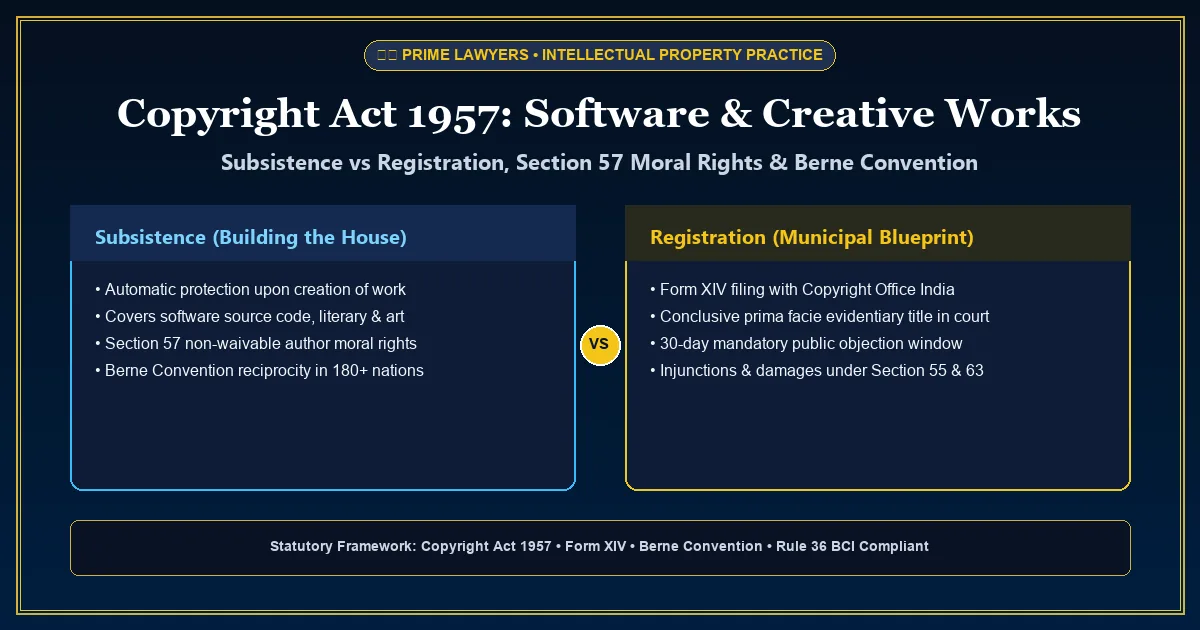
Legal dissection of Form XIV registration, automatic subsistence vs evidentiary value under Section 48, Section 57 non-waivable moral rights, and software source code.
Bar Council of India Statutory Compliance & Educational Notice (BCI Rule 36): This legal treatise is authored and published exclusively for academic research, legal education, and informational purposes under the Trade Marks Act 1999, Copyright Act 1957, Patents Act 1970, and Madrid Protocol treaties. Nothing contained herein constitutes professional legal advice, formal solicitation, advertisement, or an invitation to create an advocate-client relationship. Official statutory government filing fees cited are subject to notifications by the Office of the Controller General of Patents, Designs and Trade Marks (CGPDTM) and WIPO. Readers requiring counsel on specific intellectual property disputes or filings should seek independent professional legal advice before competent authorities or High Courts.
Ms. Priya & Mr. Kabir
Ms. Priya & Mr. Kabir
Legal Counsel Support (Prime Lawyers)
👋 Welcome to Prime Lawyers! Submit your inquiry below for immediate record and direct counsel follow-up.