An authoritative legal treatise on the Copyright Act, 1957: examining software source code protection under Section 2(o), automatic subsistence vs the evidentiary weight of Form XIV registration under Section 48, developer work-for-hire assignments, Section 57 non-waivable moral rights, and civil/criminal anti-piracy remedies.
Intellectual property jurisprudence establishes a fundamental dichotomy between ideas and expression: copyright law does not protect ideas, procedures, systems, or operational concepts *per se* [in themselves]; it protects the unique, original, tangible expression of those ideas. In India, this principle is codified within the Copyright Act, 1957 (Act No. 14 of 1957) as amended significantly in 1994, 1999, and 2012 to harmonize with digital technology and the WIPO Internet Treaties (WCT and WPPT).
Under Section 13(1) of the Act, copyright subsists throughout India in the following sovereign classes of works:
In the landmark decision of the Supreme Court of India in Eastern Book Company v. D.B. Modak ((2008) 1 SCC 1), the Court discarded the archaic English "sweat of the brow" doctrine in favor of the "modicum of creativity" standard. To claim copyright, a work must display personal intellectual effort, skill, and judgment, originating from the author rather than being a robotic copy.
Article 5(2) of the Berne Convention for the Protection of Literary and Artistic Works (1886) establishes the foundational global canon: the enjoyment and exercise of copyright shall not be subject to any formality. Consequently, in Indian jurisprudence, copyright subsists automatically the very millisecond a developer writes code into an IDE or an author pens text onto paper.
Why, then, do seasoned corporate attorneys and IP practitioners vehemently advise technology startups and enterprises to secure formal registration via Form XIV with the Copyright Office in New Delhi? The answer lies in Section 48 of the Copyright Act, 1957.
"The Register of Copyrights shall be prima facie evidence of the particulars entered therein and extracts from the Register certified by the Registrar of Copyrights and sealed with the seal of the Copyright Office shall be admissible in evidence in all courts without further proof or production of the original."
In high-stakes intellectual property litigation before a Commercial Division of the High Court, obtaining urgent ex parte ad-interim [in the absence of one party in the meantime] injunctions under Order 39 Rules 1 and 2 of the Code of Civil Procedure (CPC) requires satisfying three tests: (1) a *prima facie* [at first sight] case, (2) balance of convenience, and (3) irreparable injury.
Without a formal Registration Certificate (ROC), proving when source code was authored requires arduous forensic git commit records, notary affidavits, and expert testimony—often taking months while copycat software floods the market. Conversely, placing a certified Section 48 ROC Certificate before the Judge immediately shifts the burden of proof onto the infringer, enabling the court to grant immediate injunctive relief restraining distribution within 48 hours.
Software is the economic lifeblood of the modern technology economy. Section 2(o) of the Copyright Act explicitly incorporates computer programs within the definition of literary works, defining a computer program under Section 2(ffc) as:
"A set of instructions expressed in words, codes, schemes or in any other form, including a machine readable medium, capable of causing a computer to perform a particular task or achieve a particular result."
Both human-readable source code (written in Python, Rust, C++, JavaScript, Go) and machine-executable object code (binary .bin, bytecode) are protected. However, the most explosive legal battlefield in Indian software companies involves First Ownership of Copyright under Section 17.
Under Section 17(c), in the case of a work made in the course of the author's employment under a "contract of service", the employer is the first owner of the copyright, unless there is an agreement to the contrary.
When an Indian enterprise or startup hires an external agency, freelance developer, or third-party IT vendor, the legal relationship is a "contract FOR service", NOT a contract of service. Under Section 17, the freelance programmer retains 100% legal ownership of the source code! Paying invoices does NOT transfer copyright. To transfer title, a formal written Assignment Deed complying strictly with Section 19 (specifying royalty, duration, territory, and rights) must be executed.
Registration of copyright in India is centralized under the Copyright Office (Department for Promotion of Industry and Internal Trade - DPIIT, Ministry of Commerce and Industry) via its e-filing portal (copyright.gov.in). The procedure adheres to the Copyright Rules, 2013:
Application is lodged on Form XIV alongside the Statement of Particulars (SoP) and Statement of Further Particulars (SoFP). Statutory requirements include:
Upon fee payment, an official Diary Number (e.g., 24512/2026-CO/L) is generated. Under Rule 70(9) of the Copyright Rules, 2013, the application must undergo a mandatory 30-day statutory waiting period to invite objections from any third party claiming an adverse proprietary interest in the work.
If no objections are received within 30 days, an Examiner scrutinizes the application. If clerical errors, missing signatures, or inadequate code samples are found, an official Discrepancy Letter is issued, requiring compliance within 30 days. Once resolved, the Registrar formally approves the application and issues the Registration of Copyright (ROC) Certificate under Section 45.
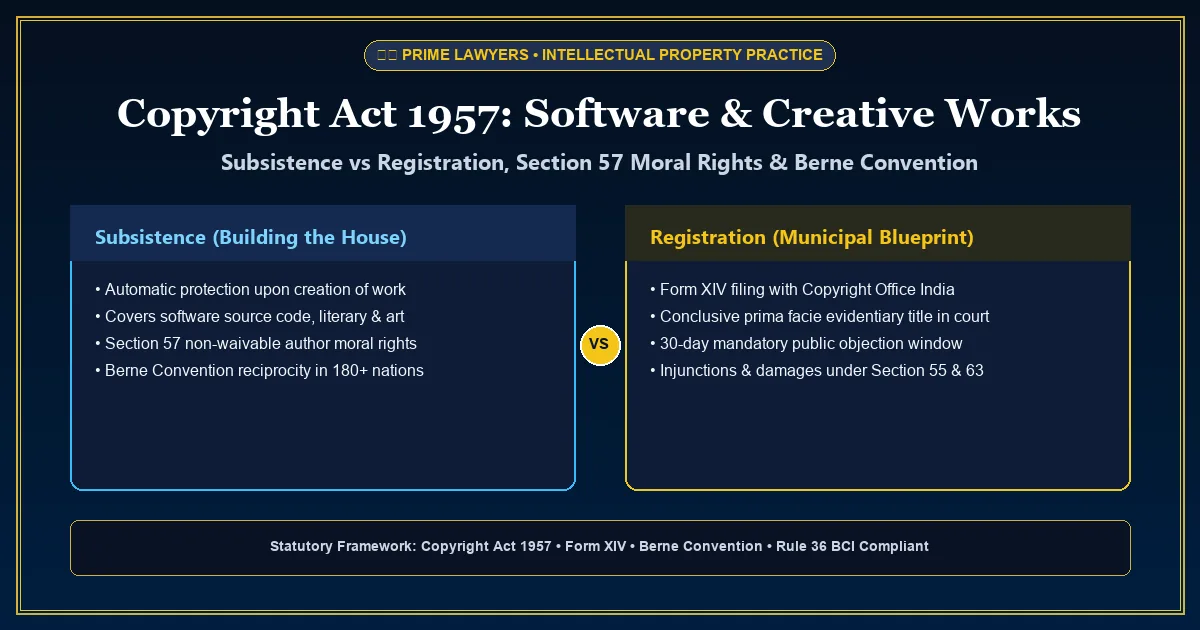
To make the subtle interplay between automatic copyright subsistence and statutory registration immediately tangible, we apply the identical Real Estate & Property Conveyancing Analogy:
When an engineer codes an algorithm or a writer completes a book, it is like buying cement and bricks and erecting a physical villa on land you own. The moment the roof is laid, the structure exists in physical reality. This is Automatic Subsistence—the house is real, tangible, and belongs to the builder.
Suppose an aggressive squatter breaks in at night, changes the locks, and tells the neighborhood that he built the house. If you never registered building plans with the municipal corporation, you have to find construction workers from two years ago, produce hardware store cement receipts, and engage in a protracted civil lawsuit lasting years while the squatter lives comfortably inside your home.
Filing Form XIV with the Copyright Office is depositing the certified architectural blueprints with the Municipal Town Planning Authority on day one. When the Registrar issues the ROC Certificate under Section 45, you hold an embossed, date-stamped government completion certificate proving exactly who built the structure on what date.
When an infringer clones your SaaS platform, you do not need to argue. You show the certified Section 48 municipal extract to the Commercial Court. The judge sees the official government seal, recognizes immediate *prima facie* ownership, and dispatches court commissioners or police to seize the infringing servers within 48 hours.
Derived from the French civil-law doctrine of Droit Moral and enshrined in Article 6bis of the Berne Convention, Section 57 of the Copyright Act, 1957 grants the author of a work special moral rights that operate completely independent of the author's economic copyright.
Under Section 57(1), independently of the author's copyright and even after the assignment either wholly or partially of the said copyright, the author shall have:
Landmark Precedent — Amar Nath Sehgal v. Union of India (2005 (30) PTC 253 Del): The celebrated sculptor Amar Nath Sehgal had created a massive bronze mural for Vigyan Bhavan in New Delhi. Decades later, during government renovations, the mural was pulled down and dumped in a storeroom, suffering damage. The Delhi High Court held that an author's moral rights under Section 57 are permanent and cannot be extinguished by state ownership or assignment. The Court awarded ₹5,00,000 in damages and ordered the return of the mural to the artist.
In the modern technology sphere, Section 57 protects software architects: while a company owns the commercial software, distorting code or stripping an architect's name in a manner that damages their professional reputation in the developer community can trigger Section 57 statutory damages.
Indian copyright legislation provides one of the most formidable enforcement frameworks in common-law jurisprudence, equipping rights holders with parallel civil remedies and coercive criminal sanctions:
Under Section 63, any person who knowingly infringes or abets infringement commits a cognizable criminal offence punishable with imprisonment from 6 months to 3 years and fine of ₹50,000 to ₹2,00,000. Under Section 64, any police officer not below the rank of sub-inspector may, if satisfied that an offence under Section 63 has been or is likely to be committed, seize without warrant all copies of the work and all plates/equipment used for making infringing copies.
Indian copyright creators operate with immense global leverage by virtue of India's international treaty commitments:
By virtue of the International Copyright Order, 1999, promulgated by the Central Government under Section 40 of the Act, any work first published in India receives National Treatment in more than 180 contracting states (including the United States, United Kingdom, European Union member states, Japan, and Australia). An Indian software developer whose SaaS platform is pirated in California or London can initiate direct legal proceedings in foreign courts relying upon their Indian statutory copyright without filing separate foreign registrations.
Under the Second Schedule to the Copyright Rules, 2013, official statutory government filing fees payable to the Registrar of Copyrights (excluding professional legal drafting) are remarkably modest:
| Nature of Work | Statutory Form | Official Statutory Govt Fee (Per Work) |
|---|---|---|
| Literary Work / Software Source Code (Unpublished) | Form XIV | ₹500 |
| Literary Work / Software Source Code (Published) | Form XIV | ₹500 |
| Artistic Work (Non-commercial packaging) | Form XIV | ₹500 |
| Artistic Work (Used or capable of being used on goods - TM Search Certificate) | Form XIV + TM-C | ₹2,000 |
| Cinematograph Film | Form XIV | ₹5,000 |
| Sound Recording | Form XIV | ₹2,000 |
No. Under the Copyright Act, 1957 and the international Berne Convention, copyright subsists automatically the moment an original work is created and fixed in a tangible medium. However, formal registration on Form XIV is practically essential because under Section 48, the Register of Copyrights serves as *prima facie* evidence of ownership in court, enabling swift *ex parte* interim injunctions against infringers without requiring exhaustive oral proof of creation dates.
Under Section 2(o) of the Copyright Act, 1957, computer software, programs, and source code are legally classified and protected as "Literary Works". When filing for registration, the applicant must submit Form XIV along with the first 10 and last 10 pages of unredacted source code or the complete source code if fewer than 20 pages, demonstrating originality and intellectual structure.
Under Section 17(c) of the Act, when work is made during the course of employment under a contract of service, the employer is the first owner of copyright unless agreed otherwise. Conversely, software built by an independent contractor or external development agency belongs to the contractor unless a formal written assignment agreement complying with Section 19 is executed.
Section 57 grants authors special moral rights independent of economic copyright: the right of paternity (to claim authorship) and the right of integrity (to restrain or claim damages for any distortion, mutilation, or modification prejudicial to the author's honor or reputation). Crucially, moral rights remain with the original author even after complete commercial assignment of the copyright.
Under Section 63 of the Copyright Act, 1957, copyright infringement is a cognizable criminal offence punishable with imprisonment from 6 months up to 3 years and a fine between ₹50,000 and ₹2,00,000. Additionally, under Section 64, police officers not below the rank of sub-inspector possess statutory powers to seize infringing copies and equipment without a judicial warrant.
Yes. India is a signatory to the Berne Convention for the Protection of Literary and Artistic Works and the Universal Copyright Convention. By virtue of the International Copyright Order, 1999, works originating in India enjoy automatic reciprocal copyright protection across 180+ contracting member states without requiring separate local registrations.
Prime Lawyers collaborates with domestic enterprises, DPIIT-recognised technology startups, and international law firms seeking Indian jurisdictional representation, Madrid Protocol origin filings, PCT national phase prosecution, and High Court intellectual property litigation. In strict compliance with Bar Council of India Rule 36, all professional affiliations operate on non-solicitation, mutual professional respect, and legal academic integrity.