
1. Executive Summary: The Constitutional Bounds of Executive Power
In a constitutional democracy governed by the Rule of Law, every public authority, municipal board, and estate officer exercises only such authority as is expressly delegated by statute. The doctrine of ultra vires (literally, "beyond the powers") represents the cornerstone of judicial review under Articles 226 and 32 of the Constitution of India.
When an administrative body exercises powers not granted to it, ignores mandatory statutory conditions precedent, acts arbitrarily in violation of Article 14, or imposes draconian penalties where compensatory mechanisms exist, its actions are legally null and void ab initio. This knowledge architecture analyzes the legal principles governing administrative action, with dedicated focus on urban planning, building regulations, and property rights under the Capital of Punjab (Development and Regulation) Act, 1952 and the Chandigarh Estate Rules, 2007.
2. Master Authority Clusters: Detailed Treatises
Explore our deep-dive monographs examining specific dimensions of administrative overreach, property rights, and procedural defense:
📜 Substantive & Procedural Ultra Vires
Detailed examination of statutory limits, jurisdictional fact doctrine, patent errors of law, and Wednesbury unreasonableness in executive decision-making.
⚖️ Constitutional Limits: Arts. 14, 21 & 300A
The constitutional interface of urban planning: Right to shelter, protection against arbitrary deprivation of property, and historical property declarations.
🎯 Proportionality & Resumption Defense
The landmark ratio of Teri Oat Estates (2004), Section 8-A resumption as a weapon of last resort, and Rule 19 compounding powers.
📑 Need-Based Changes & SOP 2026
Live verified administrative framework: CHB Order dt. 03.01.2023, 10.03.2026 Implementation Order, the 2026 SOP, and structural stability certifications.
🛡️ Article 226 Writs & Speaking Orders
Remedies of Certiorari and Mandamus, overcoming the alternative remedy bar under the Whirlpool exceptions, and the speaking order mandate.
📊 Chandigarh Building Violations: A Citizen’s Guide to Rights & Rules
Essential visual guide and statutory breakdown of constitutional defenses, procedural safeguards under official circulars, and rationalized penalty rate structures.
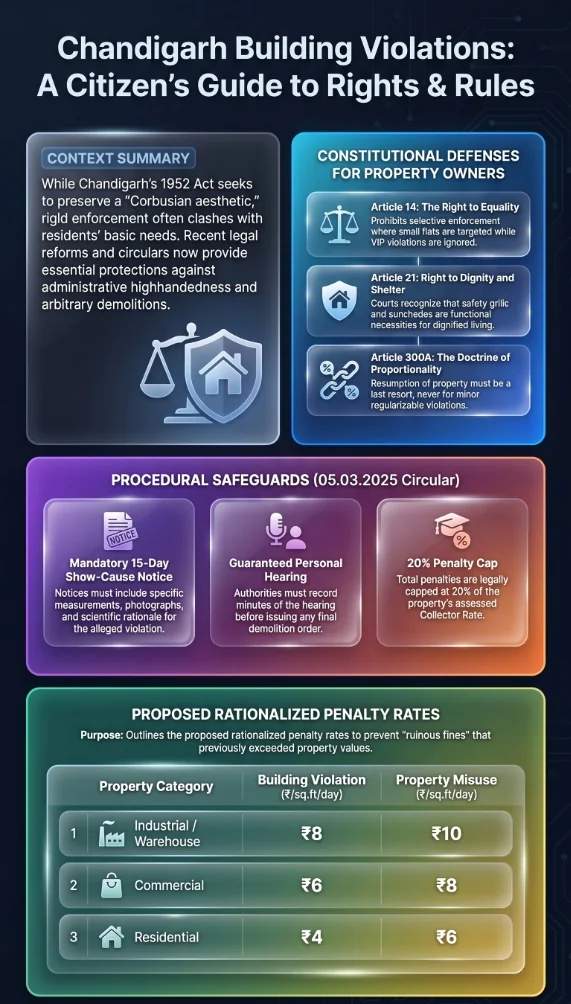
While Chandigarh's 1952 Act seeks to preserve a "Corbusian aesthetic," rigid enforcement often clashes with residents' basic human needs. Recent legal reforms, judicial directions, and administrative circulars now provide essential protections against administrative highhandedness and arbitrary demolitions.
Article 14 (Right to Equality): Prohibits selective enforcement where small dwelling units are targeted while influential commercial violations are overlooked.
Article 21 (Dignity & Shelter): Courts recognize that safety grills, sunshades, and elderly lifts are functional necessities for dignified living.
Article 300A (Proportionality): Resumption of property is an extreme sanction of last resort, never permissible for minor, regularizable deviations.
🛡️ Procedural Safeguards Mandated by Law
Mandatory 15-day prior notice returnable window. Notices must include precise measurements, photographs, and scientific rationale for the alleged violation.
Guaranteed opportunity of being heard. Authorities must record written minutes of the hearing before issuing any final demolition or resumption order.
Total statutory penalties are legally capped at 20% of the property's assessed Collector Rate to prevent ruinous, confiscatory fines.
🏷️ Proposed Rationalized Penalty Rates (To Prevent Economic Waste)
| # | Property Category | Building Violation Rate | Property Misuse Rate |
|---|---|---|---|
| 1 | 🏭 Industrial / Warehouse | ₹8 / sq.ft / day | ₹10 / sq.ft / day |
| 2 | 🛍️ Commercial | ₹6 / sq.ft / day | ₹8 / sq.ft / day |
| 3 | 🏡 Residential | ₹4 / sq.ft / day | ₹6 / sq.ft / day |
🇮🇳 चंडीगढ़ भवन नियम: प्रशासनिक मनमानी बनाम आपके संवैधानिक अधिकार
नागरिकों की सुरक्षा के लिए सरल हिंदी में विधिक सुरक्षा कवच, तोड़फोड़ से पूर्व अनिवार्य 15-दिवसीय नोटिस, और आवश्यकता-आधारित परिवर्तनों के लिए निर्धारित नियमितीकरण शुल्क।
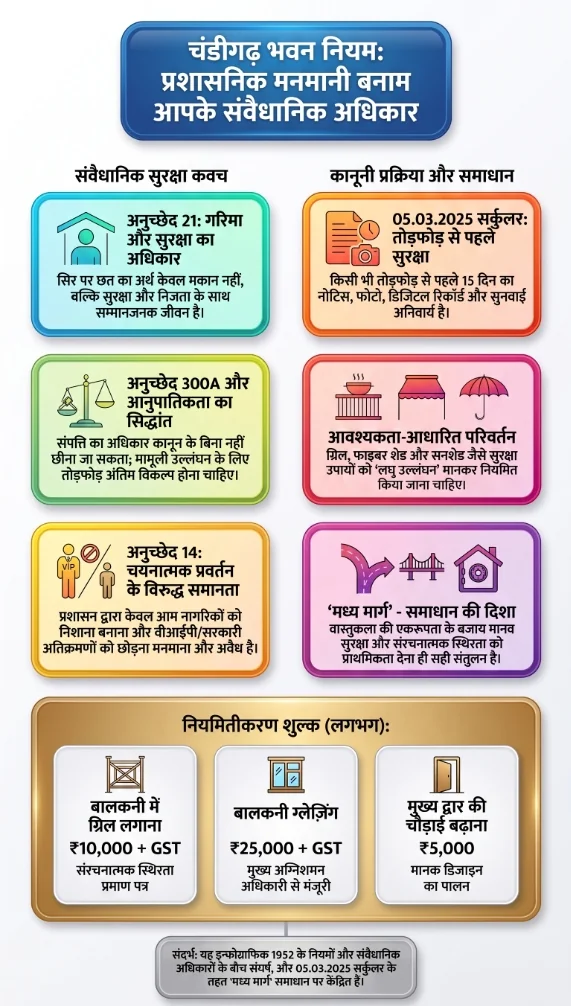
अनुच्छेद 21 (गरिमा और सुरक्षा का अधिकार): सिर पर छत का अर्थ केवल मकान नहीं, बल्कि सुरक्षा, स्वास्थ्य और निजता के साथ सम्मानजनक जीवन है।
अनुच्छेद 300A (आनुपातिकता का सिद्धांत): संपत्ति का अधिकार कानून के अधिकार के बिना नहीं छीना जा सकता; मामूली उल्लंघन के लिए तोड़फोड़ अंतिम विकल्प होना चाहिए।
अनुच्छेद 14 (चयनात्मक प्रवर्तन के विरुद्ध समानता): प्रशासन द्वारा केवल आम नागरिकों को निशाना बनाना और वीआईपी/सरकारी अतिक्रमणों को छोड़ना मनमाना और अवैध है।
तोड़फोड़ से पहले सुरक्षा: किसी भी तोड़फोड़ या सीलिंग से पहले 15 दिन का कारण बताओ नोटिस, स्पष्ट फोटो, डिजिटल माप रिकॉर्ड और सुनवाई का अवसर अनिवार्य है।
आवश्यकता-आधारित परिवर्तन: ग्रिल, फाइबर शेड और सनशेड जैसे सुरक्षा उपायों को 'लघु व शमनीय उल्लंघन' मानकर नियमित किया जाना चाहिए।
'मध्य मार्ग' - समाधान की दिशा: वास्तुकला की एकरूपता के बजाय मानव सुरक्षा, वरिष्ठ नागरिकों की सुगमता और संरचनात्मक स्थिरता को प्राथमिकता देना ही वास्तविक न्याय है।
💵 नियमितीकरण शुल्क संरचना (CHB Need-Based Regularisation Rates)
₹10,000 + GST
शर्त: पंजीकृत संरचनात्मक इंजीनियर से संरचनात्मक स्थिरता प्रमाण पत्र।
₹25,000 + GST
शर्त: मुख्य अग्निशमन अधिकारी (Fire Department) से अनापत्ति और मानक ड्राइंग।
₹5,000
शर्त: मानक डिज़ाइन और बिना कॉलम काटे सुरक्षित विस्तार।
3. The Planning Rationale: Balancing Heritage with Citizen Welfare
🏛️ The Legitimate Municipal & Architectural Rationale
Urban planning regulations exist to protect vital public interests: structural safety of buildings, prevention of fire hazards, preservation of light and ventilation, avoidance of municipal infrastructure overload, and conservation of historical architectural identity (such as Chandigarh's unique Le Corbusier modernism). No individual citizen possesses a fundamental right to compromise the structural integrity of multi-storey dwelling units or encroach upon public land.
However, constitutional governance requires that this legitimate municipal power must be exercised proportionately, reasonably, and through lawful statutory procedures. The State cannot treat minor non-structural alterations (such as internal partitions, safety grills, sunshades, or lifts for senior citizens) identically with dangerous commercial misuses or structural hazards. Planning discipline must accommodate human dignity, aging demographics, and genuine need-based adaptations.
4. 14-Point Analytical Matrix for Assessing Administrative Legality
When evaluating whether an administrative notice, sealing order, or resumption proceeding is legally sound or vulnerable to judicial review, constitutional courts apply this rigorous 14-point test:
| # | Constitutional / Legal Test | Core Question Asked by Courts | Judicial Precedent / Basis |
|---|---|---|---|
| 1 | Source of Statutory Power | What specific section or statute authorizes the executive officer to act? | Express Newspapers (1958) |
| 2 | Competent Jurisdiction | Did the acting officer hold statutory jurisdiction, or does inherent lack of jurisdiction nullify the act? | Kiran Singh (1954) |
| 3 | Validity of Delegation | Was the power lawfully sub-delegated without exceeding parent legislative boundaries? | Babu Ram Upadhya (1961) |
| 4 | Proper Statutory Purpose | Was the power invoked for genuine planning goals, or as a punitive tool? | Ramana Dayaram Shetty (1979) |
| 5 | Relevant Considerations | Did the authority consider structural stability, occupant welfare, and compounding policies? | Wednesbury (1948) |
| 6 | Exclusion of Irrelevancies | Was the order tainted by extraneous factors, arbitrary circulars, or subjective bias? | Royappa (1974) |
| 7 | Mandatory Procedure | Were statutory timelines, proper notice service, and inspection rules strictly followed? | Sharif-ud-Din (1980) |
| 8 | Natural Justice (Hearing) | Was the owner granted an effective, meaningful personal hearing before adverse action? | Swadeshi Cotton Mills (1981) |
| 9 | Speaking / Reasoned Order | Does the order record clear, cogent reasons addressing the citizen's factual defense? | Kranti Associates (2010) |
| 10 | Proportionality Test | Is the penalty (e.g. resumption) the least restrictive lawful means to achieve compliance? | Teri Oat Estates (2004) |
| 11 | Article 14 Non-Arbitrariness | Are similarly situated properties granted compounding while the petitioner is targeted? | Maneka Gandhi (1978) |
| 12 | Article 300A Safeguards | Is the citizen being deprived of property rights without explicit statutory authority? | Hari Krishna Mandir (2020) |
| 13 | Available Statutory Remedies | Do statutory appeals under Section 10/11 exist, or do Whirlpool exceptions justify writ? | Whirlpool Corp. (1998) |
| 14 | Evidentiary Completeness | Do sanction plans, allotment letters, and structural certificates disprove allegations? | Babu Singh Bains (1997) |
5. Official Regulatory Orders & Live Verification Links
To ensure total transparency and verifiable evidence, all research on this hub is directly grounded in official gazettes, court law reports, and verified administrative orders:
-
Chandigarh Housing Board (CHB) Need-Based Orders (10 March 2026): Official portal publishing implementation of Order No. 02 dt. 03.01.2023 for need-based changes.
Open Live Official CHB Portal ↗ -
CHB 2026 Standard Operating Procedure (SOP): Official downloadable SOP governing approval and regularisation of additional construction in dwelling units.
Download Official SOP Document (PDF) ↗ -
Structural Stability Proforma: Prescribed certificate of structural stability required from registered structural engineers for compounding.
Download Structural Stability Proforma (PDF) ↗
Chambers Collegial Forum: Subject Consultation & Public Pain Research for Legal Practitioners
Under the framework of professional fraternity and civic jurisprudence, our Chambers actively welcomes practicing advocates, Bar Association colleagues, researchers, and public policy scholars seeking subject-matter consultation, technical statutory interpretation, or collaborative academic analysis on Urban Planning Overreach & Ultra Vires Administrative Action.
🔍 Probing the Ground Realities ("The True Pain of the Public"):
Decades of rigid building bye-laws, retrospective resumption notices, non-speaking administrative rejections, and bureaucratic delays have created acute, unredressed distress for thousands of law-abiding property owners, elderly citizens, and middle-class families in Chandigarh. We regularly exchange technical legal notes, procedural precedent, and empirical documentation with fellow members of the Bar to assist them in formulating rigorous, evidence-based challenges before statutory appellate authorities and the High Court of Punjab & Haryana.
Statutory Notice: In accordance with Bar Council of India regulations, this forum is strictly non-solicitation and serves exclusively for professional discourse, legal scholarship, and academic analysis.
6. Frequently Asked Legal Questions
What is the distinction between substantive and procedural ultra vires?
Substantive ultra vires occurs when an authority acts on a subject matter or makes a decision that it has no legal power to make under the parent statute. Procedural ultra vires occurs when the authority has general statutory power, but fails to observe mandatory procedures, statutory notice timelines, or natural justice before passing the order.
Can an Estate Officer immediately order demolition or resumption upon alleging a violation?
No. Section 8-A of the Capital of Punjab Act, 1952 expressly requires a prior show-cause notice and a reasonable opportunity of being heard. Furthermore, the Supreme Court in Teri Oat Estates (2004) ruled that resumption is a weapon of last resort and cannot be invoked if the alleged deviation is compoundable, minor, or rectifiable.
How does Rule 19 of the Chandigarh Estate Rules, 2007 provide relief?
Rule 19 vests discretionary power in the Administrator to relax the application of any rule in exceptional circumstances and in the public interest, for reasons recorded in writing. This provision has historically enabled compounding and regularization schemes for need-based alterations.
What should an allottee or property owner do immediately upon receiving a building notice?
Immediately preserve the postal envelope to establish the date of receipt, obtain complete sanctioned building plans and allotment records, prepare a comprehensive factual and legal reply within the prescribed limitation period, invoke relevant compounding/regularisation provisions, and formally request a personal hearing with a speaking order.