
Chandigarh Estate Rules and Citizens’ Fundamental Rights: Constitutional Balance Between Urban Planning, Privacy, Safety and Right to Property
A constitutional analysis of boundary walls, security structures, need-based constructions and administrative accountability under the Capital of Punjab (Development and Regulation) Act, 1952.

1. Constitutional Vision of a Welfare State
India is a constitutional democracy governed by the rule of law, wherein every exercise of executive authority must harmonize public welfare with fundamental individual liberties. Urban planning regulations—such as those enacted under the Capital of Punjab (Development and Regulation) Act, 1952 and the Chandigarh Lease-Hold of Sites and Buildings Rules, 1973—are undoubtedly essential for maintaining municipal order, protecting the environment, and preserving architectural integrity. However, statutory planning powers cannot be permitted to degenerate into unfettered administrative discretion that operates in total disregard of human dignity, personal safety, and the practical necessities of citizens.
The Supreme Court of India has consistently held that statutory provisions granting regulatory authority must be interpreted in alignment with Part III of the Constitution. The fundamental right to life guaranteed under Article 21 is not merely restricted to physical existence; it encompasses the right to live with human dignity, personal security, and privacy. As established in the landmark 9-judge bench ruling in Justice K.S. Puttaswamy (Retd.) v. Union of India (2017), privacy is an intrinsic element of life and personal liberty, extending to a citizen’s private home and immediate domestic surroundings.
2. The Doctrine of Constitutional Proportionality
To withstand constitutional scrutiny under Article 14 (Equality before Law) and Article 21 (Right to Life and Liberty), any administrative restriction imposed upon a property owner’s enjoyment of their home must satisfy the strict four-prong test of constitutional proportionality:
- Legitimate Goal: The state measure must pursue a legitimate public purpose authorized by law.
- Rational Nexus: There must exist a rational connection between the restrictive regulation and the objective sought to be achieved.
- Necessity (Least Restrictive Means): The state must demonstrate that no less intrusive alternative is available to achieve the municipal objective without inflicting disproportionate hardship.
- Proportionality Stricto Sensu: The public benefit achieved by the restriction must demonstrably outweigh the severity of hardship inflicted upon the citizen's fundamental rights.
Where a rigid building regulation penalizes minor protective measures—such as height-adjusted boundary walls, security grills, or weather protection sheds—without demonstrating any tangible public nuisance or structural danger, such enforcement fails the test of proportionality and risks invalidation as arbitrary state action.
3. Right to Safety, Privacy and Protection of Domestic Residence
A citizen's residential property is not merely an architectural asset; it serves as a sanctuary of personal safety, dignity, and private life. Article 21 protects the right to control access to personal spaces. In urban centers like Chandigarh, security concerns—including criminal trespass, burglary, and privacy invasion from adjoining public roads—are genuine realities.
When residents install essential security structures (such as protective boundary gates, safety grills, or temporary sunshades), administrative bodies must evaluate these structures from the standpoint of actual human safety and privacy needs rather than enforcing blind, mechanical visual uniformity. Treating basic safety installations as grave "building violations" ignores the constitutional duty of a welfare state to safeguard its citizens.
4. Special Protections for Senior Citizens and Vulnerable Residents
A constitutional state is under a positive obligation to adopt a humane, empathetic approach toward vulnerable societal groups, including senior citizens, single occupants, women, and persons with disabilities. Elderly residents frequently require specific need-based modifications—such as ramp access, ground-floor safety barriers, and security enclosures—to live independently and safely.
Applying rigid, unyielding administrative penalties or threats of property resumption under Section 8A against elderly occupants for functional security modifications breaches the statutory spirit of the Maintenance and Welfare of Parents and Senior Citizens Act, 2007 and fundamental constitutional compassion.
5. Right to Property Under Article 300A
Although the right to property ceased to be a fundamental right following the 44th Constitutional Amendment in 1978, it remains a vital Constitutional Right under Article 300A and a recognized human right. Article 300A mandates that no person shall be deprived of their property except by authority of law.
The Supreme Court has held that "deprivation of property" includes unreasonable statutory interference that renders a citizen's lawful property unuseable or subjects it to harsh threats of cancellation and resumption for non-injurious, compoundable alterations. Executive actions under the 1952 Act must adhere strictly to fair procedural safeguards.
6. Limits on Administrative Discretion & Duty to Act Reasonably
Statutory authorities, including the Estate Officer and Chief Administrator, do not possess unfettered discretion. Under principles of administrative law, statutory discretion must be exercised:
- With Reasoned Orders: Passing speaking orders that explicitly address the citizen's safety objections.
- Without Inordinate Delay: Processing compounding plans and need-based applications within reasonable, published timeframes.
- Consistently: Ensuring similarly situated property owners are treated equally without discriminatory enforcement.
7. Alignment with International Human Rights Covenants
India's constitutional jurisprudence is enriched by international human rights instruments to which India is a signatory state:
- Universal Declaration of Human Rights (UDHR) Article 12: Protects individuals against arbitrary interference with privacy, family, home, or correspondence.
- International Covenant on Civil and Political Rights (ICCPR) Article 17: Mandates statutory protection against unlawful or arbitrary interference with a person's private domestic sanctuary.
- International Covenant on Economic, Social and Cultural Rights (ICESCR) Article 11: Recognizes the right of every individual to an adequate standard of living, including safe, dignified housing.
8. Frequently Asked Questions (Constitutional FAQs)
Q1. Can Chandigarh Administration regulate construction on private property?
Yes. The Administration can regulate land use and construction under valid municipal statutes. However, such regulations must comply with constitutional principles of fairness, reasonableness, non-arbitrariness under Article 14, and the doctrine of proportionality.
Q2. Is privacy inside a residential property a fundamental right?
Yes. The Supreme Court in Puttaswamy (2017) declared privacy to be an intrinsic part of the fundamental right to life and personal liberty guaranteed under Article 21 of the Constitution.
Q3. Can every boundary wall or security structure be prohibited as a violation?
Regulations may control architectural specifications, but absolute prohibitions against essential security structures required for personal safety and crime prevention violate the constitutional requirement of reasonableness.
Q4. Can administrative authorities keep compounding applications pending indefinitely?
No. Administrative authorities must act reasonably and within defined timeframes. Inordinate, unexplained delays in deciding compounding applications amount to administrative arbitrariness under Article 14.
Q5. Does Article 300A protect property rights against executive overreach?
Yes. Article 300A guarantees that no citizen shall be deprived of property except by authority of law, ensuring protection against arbitrary executive actions or unreasoned cancellation orders.
🌐 Authenticated Legal & Judicial References
- ⚖️ Puttaswamy Right to Privacy Judgment: Justice K.S. Puttaswamy (Retd.) v. Union of India (IndianKanoon) »
- ⚖️ Privacy Law Repository: Puttaswamy Case Summary (CCG NLU Delhi) »
- ⚖️ Maneka Gandhi Due Process Principle: Maneka Gandhi v. Union of India (Manupatra Academy) »
- ⚖️ Inclusive Public Space Study: India Urban Rights Legal Report (University of Leeds) »
Violations of Urban Planning by Chandigarh Administration Under Indian Constitution
Explore our visual legal mindmap analyzing Justifiable Powers (Intra Vires) vs. Unreasonable Restrictions (Ultra Vires) under Articles 14, 19(1)(g), 21, and 300A.
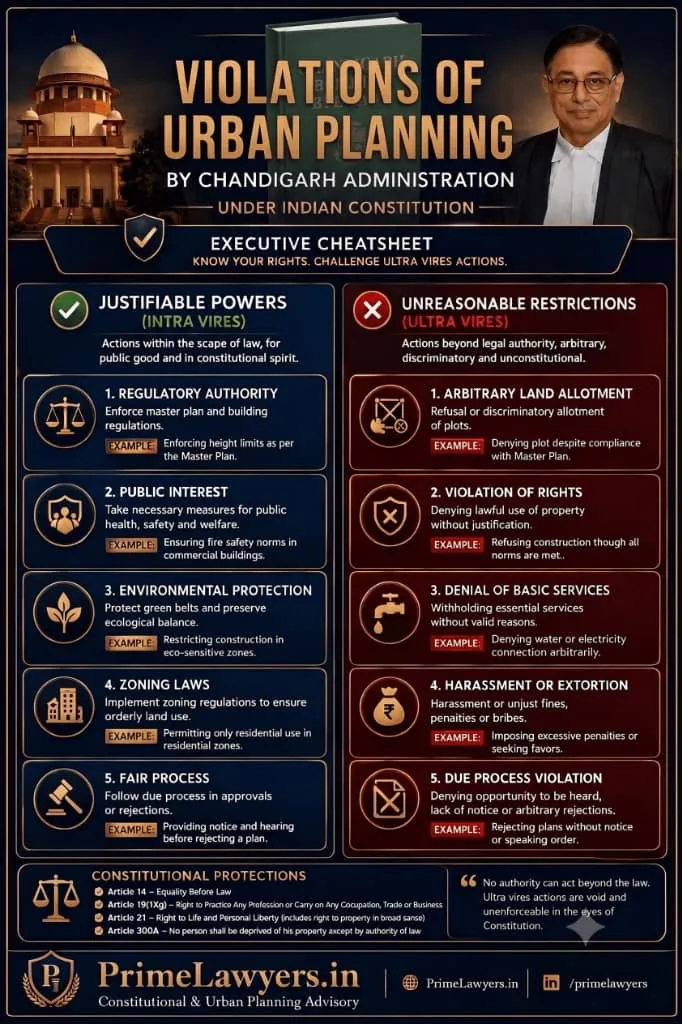
Chandigarh Estate Office Notices, Resumption Defense & Property Rights Hub »
Authored by Adv. Shakti Kumar Jain (High Court Practice Counsel). Explore the comprehensive 7-part legal defense series, bilingual (English/Hindi) procedural checklists, and landmark High Court precedents protecting property owners against arbitrary demolition notices, Section 8A resumption traps, and FAR weaponisation.