
Violations of Urban Planning by Chandigarh Administration: Constitutional Mindmap & Legal Analysis
An executive cheatsheet and constitutional treatise mapping justifiable statutory powers (Intra Vires) against arbitrary executive overreach (Ultra Vires) under the Capital of Punjab (Development and Regulation) Act, 1952.
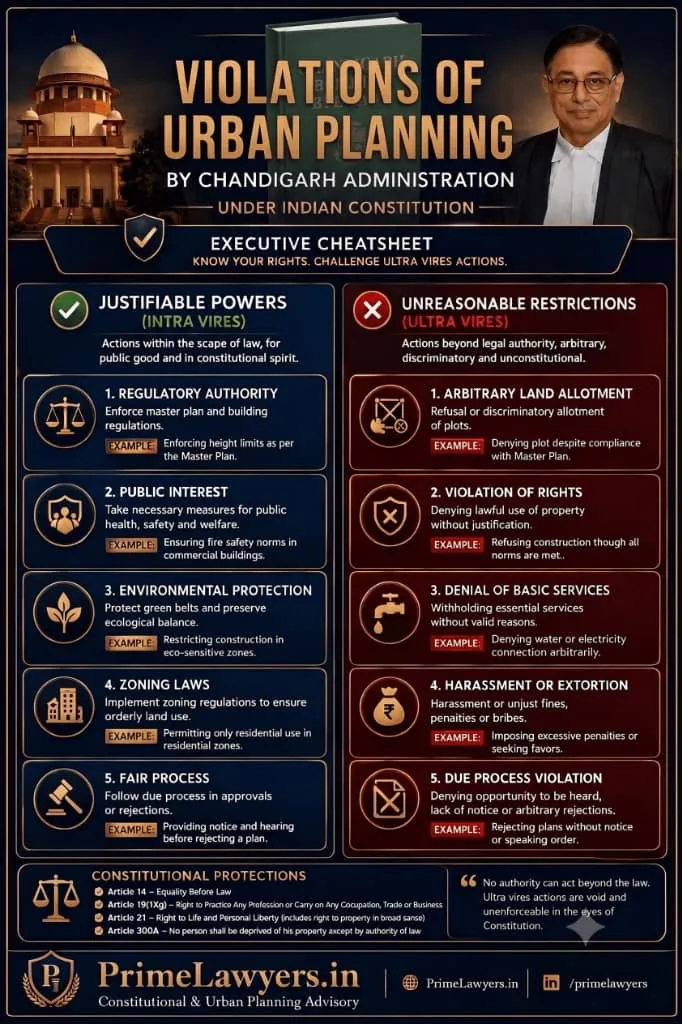
Executive Cheatsheet: Know Your Constitutional Rights. Challenge Ultra Vires Administrative Actions.
💡 What Does This Mindmap Mean for Property Owners?
Imagine the Chandigarh Estate Office as a school principal enforcing rules for the playground.
- Justifiable Powers (Intra Vires = Within the Law): The principal has full right to stop kids from running onto dangerous roads or breaking building fire safety rules. Enforcing height limits, protecting green parks, and requiring proper approvals are completely legal and necessary for everyone's benefit.
- Unreasonable Restrictions (Ultra Vires = Beyond the Law / Illegal Abuse): But if the principal suddenly locks out a student from using water fountains, refuses to let a child enter school because of an old minor rule without giving them a chance to speak, or tries to take away their schoolbag permanently for a tiny mistake—that principal is abusing their power!
Bottom Line: Government officers have authority to plan cities, but they DO NOT have authority to act like dictators or ignore your Constitutional rights!
🛡️ : The Administration’s Strongest Legal Argument
To evaluate urban planning law fairly, we must consider the State's perspective. Chandigarh is an internationally acclaimed planned city designed by Le Corbusier. Under the Capital of Punjab (Development and Regulation) Act, 1952, statutory planning authorities are entrusted with the duty to prevent chaotic urban decay, protect ecological green belts, maintain traffic safety, ensure uniform architectural aesthetics, and protect commercial zoning limits against un-checked commercialization. Without strict enforcement of master plans, public infrastructure like sewage, electricity grids, and roads would collapse under unregulated structural overload.
⚖️ : Why Constitutional Primacy Overrides Administrative Overreach
While urban planning is a valid state interest, statutory administrative powers can NEVER override Part III Fundamental Rights guaranteed by the Constitution of India. When executive officers exercise statutory powers under the 1952 Act in an arbitrary, heavy-handed, or non-speaking manner, their actions become Ultra Vires (void in law):
- Article 14 (Equality & Non-Arbitrariness): Administrative decisions must be non-discriminatory. Selective enforcement against one plot holder while ignoring identical neighboring deviations violates Article 14 (E.P. Royappa v. State of Tamil Nadu).
- Article 19(1)(g) (Right to Trade & Business): Arbitrarily sealing commercial premises or denying plot allotment despite full compliance restricts a citizen's fundamental right to earn a livelihood.
- Article 21 (Right to Life & Personal Liberty): Extends beyond mere animal existence to encompass domestic privacy (Puttaswamy 2017), personal security, and basic human dignity. Withholding essential water or electricity connections arbitrarily violates Article 21.
- Article 300A (Right to Property): Property rights are human rights. As affirmed in Dheera Singh v. UT Chandigarh (2024), property resumption is an extreme measure of last resort, permissible only when deviations are grave, non-compoundable, and after exhausting all reasonable opportunities.
Frequently Asked Questions (Mindmap Legal Principles)
Q1. What is the difference between Intra Vires and Ultra Vires administrative actions?
Intra Vires actions are lawful administrative decisions taken strictly within statutory authority for public welfare. Ultra Vires actions exceed statutory authority, violate constitutional rights, or operate arbitrarily without due process.
Q2. Can the Chandigarh Estate Officer withhold essential utility services like water or electricity?
No. Withholding essential water or electricity connections arbitrarily without statutory authorization or due process violates the right to basic human dignity guaranteed under Article 21 of the Constitution.
Q3. How does Article 300A protect property owners against arbitrary resumption?
Article 300A mandates that no person shall be deprived of property except by authority of law. As held in Dheera Singh v. UT Chandigarh (2024), resumption is an extreme measure of last resort permissible only when deviations are grave and non-compoundable.
🔗 Related Chandigarh Estate Office Articles & Legal Analyses
Chandigarh Estate Office Resumption Notices: Legal Defense Strategy
Comprehensive procedural defense guide explaining statutory appeals, financial compounding, and staying arbitrary resumption orders.
Chandigarh Estate Rules vs. Citizens’ Fundamental Rights: Constitutional Balance
A deep constitutional analysis covering Articles 14, 21, 300A, Puttaswamy right to privacy, and the Doctrine of Proportionality.
Chandigarh Estate Office Notices, Resumption Defense & Property Rights Hub »
Authored by Adv. Shakti Kumar Jain (High Court Practice Counsel). Explore the comprehensive 7-part legal defense series, bilingual (English/Hindi) procedural checklists, and landmark High Court precedents protecting property owners against arbitrary demolition notices, Section 8A resumption traps, and FAR weaponisation.