Table of Contents
Introduction: The Facade of "Urban Planning"
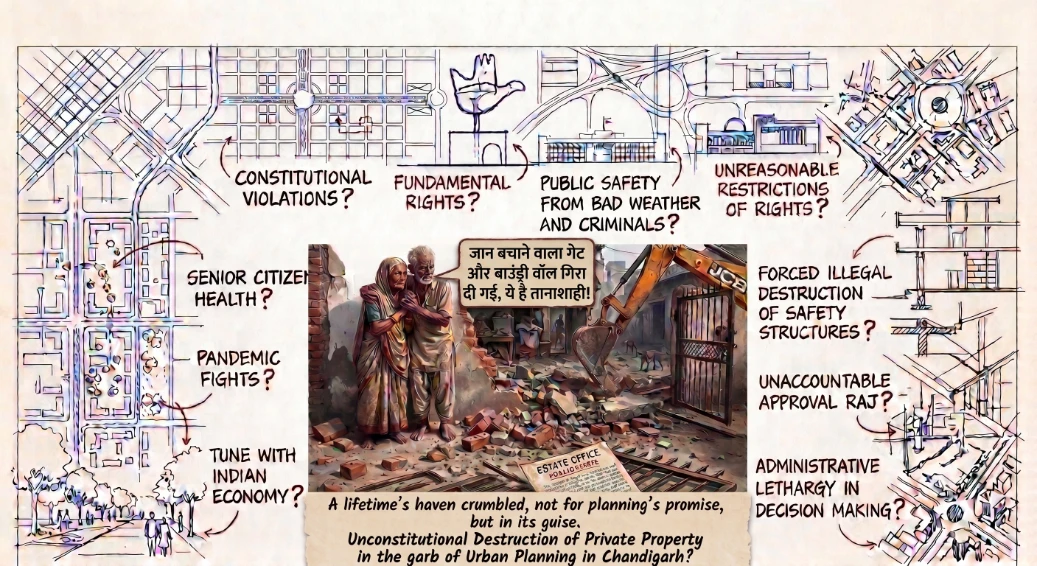
The urban development of Chandigarh, governed primarily by the Capital of Punjab (Development and Regulation) Act, 1952, was conceptualised as a "living organism" reflecting freedom from the traditions of the past. However, over the decades, the administration of this framework has degraded into a rigid, mechanical application of building bylaws. The tension between preserving the city's Corbusian aesthetic and protecting fundamental human rights has created a systemic crisis, resulting in over 5,000 pending building violation cases2 and widespread anxiety in residential sectors. Under the guise of "heritage preservation," authorities are arbitrarily classifying minor, functional necessities — such as safety grills and protective sheds — as severe structural violations.
Institutional Hypocrisy: One Law for Them, Another for Us
At the heart of the crisis is the glaring violation of Article 14 (Right to Equality). The Chandigarh Administration routinely penalises citizens for minor need-based residential alterations while exempting its own powerful apparatus.
- Government Violations: The Sector 22 Police Station has operated from residential quarters for decades, and the SDM (South) Office operates out of the Sector 42 Hockey Stadium.
- The Secret AWHO Order: The Administration issued a "secret" compounding order on 17.09.2010 allowing wide-ranging relaxations — including temporary sunshades, sliding grills, and extended rooms — for the Army Welfare Housing Society (AWHO) in Sector 47-C. Yet, it explicitly refused to treat this as a precedent for other societies.1
This selective enforcement strips the administration of its moral and legal authority, turning legitimate urban planning into hostile discrimination.
Secret Rules and Defiance of Supreme Court Mandates
To curb arbitrary bulldozing, strict procedural safeguards were established under the 05.03.2025 Circular3, which mandates that no demolition can occur without:
- A prior 15-day show-cause notice containing specific measurements and photographs,
- A digital intimation to the District Magistrate, and
- A guaranteed personal hearing.
Despite these clear Supreme Court-aligned instructions, field officers (like the SDO Buildings) systematically defy the circular. Notices remain vague and conclusory, lacking scientific rationale, precise dimensions, or statutory citations. This constitutes willful contempt and transforms the Estate Office's procedures into a coercive tool rather than an inquiry into facts.
The FAR Fraud: Weaponising Commercial Rules Against Homeowners
Floor Area Ratio (FAR) is fundamentally a zoning tool designed to regulate commercial builders and prevent the over-exploitation of urban infrastructure. In Chandigarh, this tool has been perversely weaponised against homeowners. When a resident adds a lightweight fiber shade or a boundary wall grill for domestic security, authorities routinely penalise them under FAR violations.
Furthermore, the Administration's own e-Suvidha book permits residential professional offices (for advocates, architects, etc.) of a prescribed size. Yet, enforcement officials often target these same survival-based micro-enterprises with ruinous penalties — sometimes exceeding 20% of the property's collector rate — forcing citizens into a corrupt "Approval Raj."
🔴 The Core Issues at a Glance
1. Selective Enforcement. The State applies its own rules to citizens but not to itself (police stations, SDM offices, AWHO).
2. Procedural Defiance. Field officers openly flout the 05.03.2025 Circular — vague notices, no measurements, no personal hearing.
3. FAR Weaponisation. A zoning tool meant for commercial builders is being used to penalise homeowners for safety grills and sunshades.
4. Disproportionate Penalties. Charges exceeding 20% of collector rate push residents into an "Approval Raj" of compounding fees.
5. Constitutional Erosion. Articles 14, 21, and 300A are routinely overridden by an aesthetic over a human right.
Constitutional Defenses: Articles 14, 21, and 300A
The mechanical demolition of need-based changes faces severe constitutional headwinds:
- Article 21 (Right to Life & Shelter): The Supreme Court has expansively ruled that the right to shelter is not a mere roof over one's head, but the right to adequate living space, safety, and a decent structure.4 The State's obsession with 4-foot boundary walls ignores rising crime rates, actively endangering single-living senior citizens and widows.
- Article 300A (Right to Property & Proportionality): The State cannot seize or demolish a property for a minor violation. In Dheera Singh v. U.T. Chandigarh Administration5, the Full Bench established that property "resumption" must strictly be a last resort.
- The "Functional Necessity" Precedent: In the "High Court Verandah Case" (Chandigarh Administration v. Registrar General, High Court of Punjab and Haryana)6, the Supreme Court struck down Chandigarh's "heritage-over-everything" argument, allowing the High Court to build a verandah to protect litigants from the weather. By extension, ordinary citizens cannot be denied identical functional necessities (like sunshades or security gates) using the same excuse of heritage preservation.
The "Middle Path" Solution
The conflict between architectural uniformity and human necessity demands a balanced "Middle Path." While the 2026 Need-Based Changes Standard Operating Procedure (SOP)7 provides a pathway for regularising specific modifications like balcony glazing and grill installations (for a fee of ₹10,000 to ₹25,000), it remains highly restrictive and excludes the Phase-I sectors.
A true constitutional equilibrium requires the Administration to adopt a self-certification regime for minor, non-structural residential safety features. The State must disclose the scientific and technical rationale for its restrictions and stop sacrificing the safety, economic welfare, and dignity of its residents on the altar of rigid aesthetics.
"The welfare law exists to protect the citizen and the nation's wealth. It will not serve as a shield for the extortionist." — PrimeLawyers, pro bono public legal literacy initiative
Resources & Footnotes
Every claim in this article is anchored to a verifiable primary source. Click any reference number in the body above, or browse the full list below.
- Residents Welfare Association vs The Union Territory Of Chandigarh (2023). Petition challenging the selective enforcement of building bylaws. https://indiankanoon.org/doc/80353964/
- Chandigarh moves to rationalise penalties in over 5,000 building violation cases. Hindustan Times (city desk). https://www.hindustantimes.com/cities/chandigarh-news/chandigarh-moves-to-rationalise-penalties-in-over-5-000-building-violation-cases-101768076243922.html
- UT issues new guidelines for razing illegal constructions; digital record of notices must (05.03.2025 Circular). Times of India. https://timesofindia.indiatimes.com/city/chandigarh/ut-issues-new-guidelines-for-razing-illegal-constructions-digital-record-of-notices-must/articleshow/118982438.cms
- Chameli Singh and Ors. vs. State of U.P. and Ors. Right to adequate housing under Article 21. https://clpr.org.in/wp-content/uploads/2024/12/62.-Chameli_Singh_and_Ors_vs_State_of_UP_and_Ors_151210117s960693COM157762.pdf
- Dheera Singh Vs. UT Chandigarh Admn. Full Bench — proportionality in property "resumption." https://www.the-laws.com/Encyclopedia/browse/Case?caseId=612102790100&title=dheera-singh-vs-ut-chandigarh-admn
- Chandigarh Administration v. Registrar General, High Court of Punjab and Haryana (The Verandah Case). The "functional necessity" precedent. https://www.supremecourtcases.com/chandigarh-administration-v-registrar-general-high-court-of-punjab-and-haryana-chandigarh-and-others/
- Chandigarh Housing Board issues SOP for 'need-based changes' (2026). Hindustan Times. https://www.hindustantimes.com/cities/chandigarh-news/chandigarh-housing-board-issues-sop-for-need-based-changes-101773262640579.html