
🏛️ Official Government Websites & SDM Directory (Chandigarh UT)
Access official administrative news, public notices, and revenue court listings directly from the Chandigarh Administration, Deputy Commissioner Office, and SDM Portals:
- SDM Central Court Chandigarh Official Website: https://estateoffice.chd.gov.in/ »
- SDM South Chandigarh (Official NIC Portal): https://informatics.nic.in/news/268 »
- SDM East Chandigarh (UT Administration Directory): https://chandigarh.gov.in/sdm-east »
- Chandigarh Administration Official Portal: https://chandigarh.gov.in/ »
- Chandigarh Deputy Commissioner (DC Office & District Magistrate): https://chddc.gov.in/ »
- Chandigarh Estate Office Official Portal: https://estateoffice.chd.gov.in/ »
1. Statutory Genesis: Capital of Punjab (Development & Regulation) Act, 1952
When analyzing the regulatory and administrative framework governing property and urban planning in the Union Territory of Chandigarh, we must comprehensively examine the statutory mechanisms deployed to maintain the architectural and structural integrity of the city. We recognize that the enforcement of urban discipline relies heavily on a structured delegation of authority. Specifically, we focus on the delegated role of Sub-Divisional Magistrates (SDMs) acting as Estate Officers or Assistant Estate Officers, who are empowered to issue statutory notices upon the technical recommendations and reports generated by the Sub-Divisional Officer (SDO) (Buildings). This process is firmly anchored in the Capital of Punjab (Development and Regulation) Act, 1952, the Chandigarh Estate Rules, 2007, and the applicable Building Bye-laws. In this extensive treatise, we will delineate the exact procedures utilized to summon and hear respondents, evaluate allegations of building violations, and adjudicate disputes while strictly adhering to the principles of natural justice and constitutional mandates.
To understand the jurisdictional authority of the SDMs and the SDO (Buildings), we must first look to the parent statute: the Capital of Punjab (Development and Regulation) Act, 1952. Enacted to ensure the planned development of the new capital city, the Act vests sweeping regulatory powers in the Central Government and the Chief Administrator.
- Section 3 (Power to Transfer Land): Under Section 3 of the Act, the government holds the power to transfer land and buildings subject to stringent statutory conditions.
- Section 6 (Notice for Maintenance & Building Use): Section 6 grants the authority to require the proper maintenance of any site or building, empowering the administration to serve a notice on the transferee or occupier if the condition or use of the property prejudicially affects proper planning or public amenities.
- Section 8A (Resumption and Forfeiture): Section 8A introduces the draconian but necessary provisions for the resumption and forfeiture of properties in cases involving a persistent breach of the conditions of transfer.
- Geographical Delegation to SDMs: Because the Chief Administrator cannot personally oversee every structural deviation or misuse across the city, these extensive powers are delegated to the Estate Officer, and by extension, geographically distributed to the Sub-Divisional Magistrates (SDM Central, SDM East, and SDM South).
2. The Technical Vanguard: Role and Functions of the SDO (Buildings)
Before any adjudicatory process commences, an administrative trigger is required. We identify the Sub-Divisional Officer (SDO - Buildings) as the primary technical vanguard of the Estate Office. The SDO (Buildings), supported by a team of Building Inspectors, is tasked with the continuous surveillance of residential, commercial, and industrial plots to detect unauthorized constructions, deviations from the sanctioned building plans, Floor Area Ratio (FAR) violations, and unlawful changes in land use (misuse).
- Surveillance & Field Site Inspections: When the SDO (Buildings) conducts a site inspection and identifies a transgression against the Chandigarh Building Rules (Urban), 2017 or the Chandigarh Estate Rules, 2007, they compile a detailed site report.
- Technical Inspection Dossier: This technical report maps the exact nature of the deviations—such as illegal encroachments on government land, unauthorized additional stories, or the operation of commercial enterprises within residential zones.
- Initiating Authority & Complainant: The SDO (Buildings) does not possess the judicial power to penalize or resume property; instead, they forward this comprehensive technical dossier to the competent SDM/Estate Officer, effectively acting as the complainant or initiating authority on behalf of the Chandigarh Administration.
3. Issuance of Statutory Notices by the SDM & Judicial Application of Mind
Upon receiving the technical report from the SDO (Buildings), the Sub-Divisional Magistrate, exercising the delegated powers of the Estate Officer, applies their judicial mind to the allegations. We emphasize that the issuance of a Show Cause Notice is not a mere clerical act; it is the fundamental commencement of a quasi-judicial proceeding.
- Prima Facie Evaluation: The SDM evaluates whether the reported deviations constitute a prima facie violation of Section 8A of the 1952 Act or the prevailing Estate Rules.
- Specificity of Statutory Notice: If satisfied, the SDM formally issues a notice to the property owner, transferee, or occupier (the respondents/defendants). This notice must be highly specific, clearly articulating the precise nature of the building violations or misuse, the relevant statutory clauses breached, and the potential consequences—which may include the sealing of the premises, the imposition of heavy financial penalties, or the ultimate resumption of the site and forfeiture of deposited monies.
- Summoning Respondents: The notice legally compels the respondents to appear before the SDM's court on a specified date to show cause as to why punitive administrative action should not be executed against them.
4. Summoning Respondents & Upholding Constitutional Safeguards
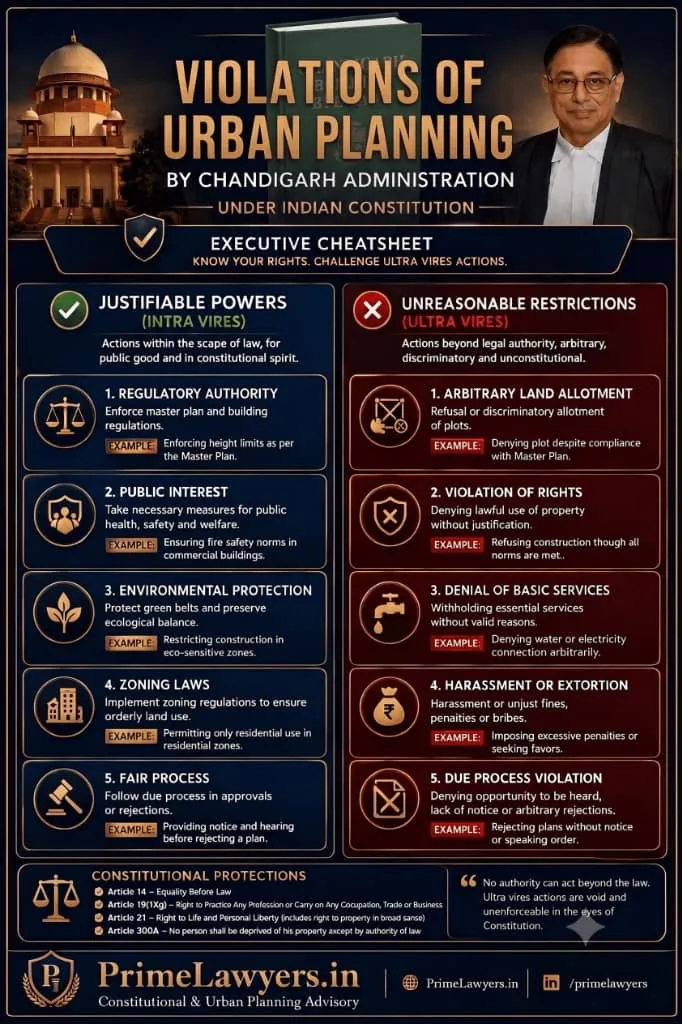
When we analyze the summoning and hearing phase, we must underscore the paramount importance of the principles of natural justice, encapsulated within the audi alteram partem (hear the other side) rule, which is inextricably linked to Article 14 (Right to Equality) of the Constitution of India. Furthermore, because the proceedings may result in the resumption of property, they directly implicate Article 300A, which explicitly states that no person shall be deprived of their property save by authority of law.
The SDM's court operates as a quasi-judicial tribunal. Once the respondents are summoned, the law mandates that they be provided with all relevant evidentiary documents relied upon by the administration. The High Court of Punjab and Haryana has consistently directed that property owners must be supplied with the complete records, including the internal inspection reports generated by the SDO (Buildings), to enable them to mount a comprehensive defense.
- File detailed written replies countering the allegations raised in the Show Cause Notice.
- Submit revised architectural drawings or compounding maps if the violations are compoundable under the building bye-laws.
- Cross-examine or question the findings of the SDO (Buildings) regarding the technical measurements of the alleged deviations.
- Engage legal counsel to represent their interests and argue the statutory interpretations of the Capital of Punjab (Development and Regulation) Act, 1952.
5. Adjudication, Evidence Evaluation, and Speaking Orders
The adjudication process overseen by the Sub-Divisional Magistrate is a meticulous balancing act. We note that the SDM must impartially weigh the technical assertions forwarded by the SDO (Buildings) against the factual and legal defenses raised by the respondents.
- Discharge of Notice: If the respondents demonstrate that the alleged violations were either pre-existing, legally compounded, or factually erroneous, the SDM has the authority to drop the proceedings and discharge the notice.
- Coercive Administrative Action: Conversely, if the deviations are proven to be non-compoundable and the respondent fails to rectify the misuse or demolish the unauthorized structure within the stipulated timeframe, the SDM is statutorily empowered to take coercive action.
- Mandatory Reasoned Speaking Order: The procedure established under law dictates that the SDM must pass a reasoned and speaking order. This order must clearly detail the facts of the case, the arguments presented by both the SDO (Buildings) and the defence, the statutory provisions invoked, and the logical rationale underpinning the final decision. A speaking order is a mandatory requirement to ensure transparency and to facilitate appellate review.
- Range of Resultant Orders: The resultant orders may range from directing the sealing of the premises, imposing environmental or administrative compensation, or, in the most severe cases of flagrant and continuous violation, ordering the cancellation of the allotment and the resumption of the property under Rule 4 and Rule 5 of the Chandigarh Estate Rules, 2007.
- De-Sealing Discretion: We must also highlight that if a respondent commits to rectifying the breach, the SDM possesses the discretionary authority to issue a de-sealing order, granting the property owner a specific time window (e.g., three months) to demolish the unauthorized deviations and restore the building to its original sanctioned plan.
- Section 145 CrPC (Sec 164 BNSS 2023) & Land Revenue Jurisdiction: In addition to Estate Office duties, SDMs exercise executive magistrate powers to determine land possession under Section 145 CrPC (Section 164 BNSS 2023) to prevent breach of peace, and act as Revenue Courts under the Punjab Land Revenue Act 1887 for demarcation and mutation appeals.
6. Appellate Mechanisms and Administrative Accountability
We must also recognize that the decisions rendered by the Sub-Divisional Magistrates are not absolute. The statutory framework provides a robust appellate hierarchy to prevent administrative overreach. Any person aggrieved by the quasi-judicial order of the SDM or Estate Officer can file an appeal before the Chief Administrator, and subsequently, a revision petition before the Advisor to the Administrator, exercising the powers of the Central Government.
This multi-tiered system ensures that the technical findings of the SDO (Buildings) and the subsequent adjudicatory rulings of the SDMs are subjected to rigorous legal scrutiny. It guarantees that the severe penalties authorized under the Capital of Punjab (Development and Regulation) Act, 1952 are not deployed arbitrarily, but are instead executed through a meticulously defined legal procedure that respects both the planned character of Chandigarh and the fundamental property rights of its citizens.
In summation, the symbiotic administrative relationship between the SDO (Buildings)—as the technical surveyor and complainant—and the Sub-Divisional Magistrate—as the adjudicating authority—forms the bedrock of urban property regulation in Chandigarh. We affirm that only by strictly adhering to these statutory delegations and providing due hearings can the administration lawfully enforce the Chandigarh Estate Rules and building bye-laws against respondents and defendants.
Acknowledging Progressive Administrative Stewardship & Judicial Responsiveness in Chandigarh UT
📜 Ms. Khushpreet Kaur, SDM (Central) & AEO-II
The author places on record profound appreciation for Ms. Khushpreet Kaur, SDM (Central) and Assistant Estate Officer-II (AEO-II), who deserves rich commendation for her open-minded and receptive approach during an exploratory dialogue held for the expression of views concerning public interest. In a meeting attended by the Author, Adv. Shakti Kumar Jain, accompanied by senior retired Ministry of Home Affairs officer Mr. Rakesh Mohan Gupta, Ms. Khushpreet Kaur engaged with utmost judicial grace, constructively agreeing with fundamental constitutional arguments aimed at safeguarding citizen rights under administrative law.
⚖️ Ms. Isha Kamboj, SDM (South) & SDO (Buildings) Mr. Sagar Saini Team
Sincere gratitude is placed on record for Ms. Isha Kamboj, SDM (South), assisted by Mr. Bhag Chand & Team and Miss Neha, for their empathetic, courteous, and transparent conduct towards suffering citizens, as well as their practice of promptly resolving revenue and estate matters on genuine legal merits.
Equally, the recent induction of the new SDO (Buildings), Mr. Sagar Saini, with a rational and citizen-aware mindset, has brought a commendable, visible improvement in field inspection procedures—a progressive reform that merits institutional preservation.
🏛️ UT Administrator Sh. Gulab Chand Kataria & Ld. District Magistrate Sh. Nishant Kumar Yadav
While direct personal meetings with the Hon’ble Administrator of UT Chandigarh, Sh. Gulab Chand Kataria, and the Ld. District Magistrate cum Deputy Commissioner, Sh. Nishant Kumar Yadav, could not be finalized owing to layered administrative scheduling protocols, we place on record our deepest appreciation for their visionary leadership. Their aggressive and proactive initiatives in steering delegatee SDMs and SDO (Buildings) teams to resolve minor building violation notices have directly driven fast-track disposal of long-pending cases, resulting in a dramatic, historic reduction of court pendencies across UT Chandigarh.
7. Landmark Precedents & Real Executive Case Studies
📋 Case Study 1: Sanction Revised Building Plans Irrespective of Proceedings in SDM Court (Estate Dept Directive - Sept 9, 2017)
In a major relief for people who have carried out building violations, the UT estate department has told its officers that revised building plans be sanctioned irrespective of the proceedings in the SDM court. If a person has done building violations and has been served a show cause notice for it, the notice would not act as a deterrent in getting him a revised building plan. But it would be released after he gets a certificate of structural stability.
The order by Assistant Secretary (Estates) stated: “It is clarified that passing of building plan or revised plan is independent of court proceedings and they should be released. Rather doing so, it will help in regularisation of some building violations at least. Thus passing and release of revised building plans needs to be delinked from pending proceedings with Sub-Divisional Magistrate or any other officer, exercising the power of estate officer under Capital of Punjab (Development and Regulation) Act, 1952.”
📋 Case Study 2: Relief for Sector 22 Resident, Won’t Have to Pay Rs 10 Lakh Fine — Double Jeopardy Rule (Apr 30, 2017)
Vinod Kumar / TNN / Apr 30, 2017, 12:32 IST
CHANDIGARH: The UT chief administrator has set aside an order of estate office imposing misuse penalty on a Sector 22 resident for sanctionable violations. Terming the order of estate office non-justifiable, chief administrator K K Jindal remanded the order back to estate office with directions to pass appropriate order afresh as per rules after giving due opportunity of a hearing to the appellant.
The SDM (central), while discharging duties of estate officer, had imposed a penalty of Rs 10 lakh under Chandigarh Estate Rules 2007 on account of violations in a house in Sector 22. As per laid down rules under the Punjab Capital (Development and Regulation) Act 1952, when a building plan has been sanctioned and the owner makes changes during the course of construction, in such cases, compounding fee at rate of Rs 5 per square feet is charged. No separate penalty can be imposed for the same cause as it amounts to double jeopardy.
During an inspection carried out at the under construction house of Raghbir Singh, it was found that the owner had raised unauthorised construction in the building plan against the sanctioned plan, which included change in planning of building, unauthorised rooms and toilets constructed in rear courtyard, unauthorised balconies, height of building raised against sanctioned plan, front and rear elevation charges and gate constructed on government land. Based on the inspection report, a show cause notice was issue on December 21, 2012, asking the owner to remove the violations. Acting on the notice, the owner submitted revised building plan on March 22, 2013, which was sanctioned on May 9, 2015. The SDM directed SDO (building) to calculate the penalty charges for building violations vide order issued on October 9, 2015. The SDM directed the owner on June 10, 2016 to deposit penalty charges. The owner moved an appeal before the chief administrator.
S K Jain and Vikas Jain, counsels for the appellant, pleaded that SDO (building) calculated the penalty charges “illegally” and “arbitrarily” and without giving the owner opportunity of being heard. The counsels contended that after receiving notice, the owner removed the violations and informed estate office on March 19, 2013. The appellant on March 22, 2013, submitted revised building plan which was sanctioned on May 23, 2013 after paying compounding fee of Rs 36,744 for regularising the minor changes. The counsels pleaded that when the violations are sanctionable and covered under revised building plan, how the estate office can impose heavy penalty without even hearing the appellant.
After hearing the case and going through the record, UT chief administrator passed the order stating: “It is evident that the appellant did his best to comply with the directions of the estate office. After issuance of show cause notice, the appellant himself set right the major violations and informed the estate office. Therefore, the act of estate office by imposing penalty charges upon the appellant on account of violations is not justifiable.”
Need Direct Legal Assistance Before the SDM Court or Collector?
Our senior advocacy team represents property owners, landlords, and commercial litigants before SDM Courts, Revenue Collectors, and the High Court in Chandigarh.
📞 Need Help? Contact Us Page »8. Frequently Asked Questions (SDM Duties, Building Notices & Revenue Laws)
1. What are the delegated duties and powers of SDMs in issuing building violation notices in Chandigarh?
SDMs in Chandigarh exercise delegated powers of Estate Officers under the Capital of Punjab Act 1952 and Chandigarh Estate Rules 2007. They issue statutory show-cause notices based on technical reports from the SDO (Buildings), summon respondents, afford due hearings, and pass reasoned adjudicatory orders.
2. What role does the SDO (Buildings) play in initiating SDM Court proceedings?
The SDO (Buildings) acts as the technical vanguard of the Estate Office, conducting surveillance, mapping FAR or misuse violations, and forwarding a detailed technical dossier to the SDM, effectively acting as the complainant on behalf of the administration.
3. Can SDM Court show-cause proceedings block the approval of a revised building plan in Chandigarh?
No. Under the UT Estate Department directive dated September 9, 2017, the approval and release of revised building plans have been explicitly delinked from pending proceedings in the SDM Court. Revised plans must be released upon submission of a structural stability certificate.
4. What is the rule against double jeopardy regarding building violation penalties in Chandigarh?
As established by the Chief Administrator in the Sector 22 landmark precedent (April 30, 2017), when building violations are sanctionable and compounded at ₹5 per sq.ft under a revised plan, the Estate Office cannot impose separate heavy misuse penalties for the same cause.
5. What constitutional protections apply to respondents facing property resumption notices?
Under Article 14 (Natural Justice) and Article 300A (Right to Property), respondents must be supplied with all internal inspection reports, granted a personal hearing, allowed to cross-examine technical findings, and given opportunity to file written replies.
6. Is an inspection report by SDO (Buildings) mandatory to be supplied to the property owner?
Yes. The High Court of Punjab & Haryana has mandated that complete evidentiary records, including SDO (Buildings) inspection reports, must be supplied to the property owner to enable a full and effective defense.
7. What happens if an SDM passes an unreasoned or non-speaking resumption order?
An unreasoned or non-speaking order violates the principles of natural justice and is liable to be set aside on appeal before the Chief Administrator or through a Civil Writ Petition under Article 226 in the High Court.
8. Can an SDM issue a de-sealing order to allow voluntary demolition of unauthorized structures?
Yes. The SDM possesses discretionary authority to issue a temporary de-sealing order granting the property owner a specific time window (e.g. 3 months) to demolish unauthorized deviations and restore the building to sanctioned plans.
9. What is the appellate hierarchy against an adverse order passed by an SDM / Estate Officer?
An appeal lies first to the Chief Administrator, UT Chandigarh (within 30 days), followed by a Revision before the Advisor to the Administrator, and ultimately a Civil Writ Petition under Article 226 before the Punjab & Haryana High Court.
10. How does compounding at ₹5/sq.ft apply to sanctionable building deviations in Chandigarh?
Under the Capital of Punjab Act 1952 and Chandigarh Building Rules, minor structural deviations that conform to overall zoning guidelines can be regularized by paying a compounding fee at ₹5 per square foot.
11. What powers does an SDM Court exercise under Section 145 CrPC (Section 164 BNSS 2023) in property disputes?
Under Section 145 CrPC (now Section 164 BNSS 2023), Sub-Divisional Magistrates (SDM) exercise executive powers to prevent breach of peace concerning land or water disputes by determining actual physical possession on the date of preliminary order, irrespective of civil title.
12. Where can official news and portals for Chandigarh SDMs and DC Office be accessed online?
Official administrative portals include SDM Central (https://estateoffice.chd.gov.in/), SDM South (https://informatics.nic.in/news/268), DC Office (https://chddc.gov.in/), and Chandigarh Administration (https://chandigarh.gov.in/).
Consult Senior Advocates for SDM & High Court Writs
For immediate court injunctions, stay orders, or appellate representation before District Magistrate / SDM Courts in Chandigarh UT.
📞 Need Help? Contact Us Page »Chandigarh Estate Office Notices, Resumption Defense & Property Rights Hub »
Authored by Adv. Shakti Kumar Jain (High Court Practice Counsel). Explore the comprehensive 7-part legal defense series, bilingual (English/Hindi) procedural checklists, and landmark High Court precedents protecting property owners against arbitrary demolition notices, Section 8A resumption traps, and FAR weaponisation.